
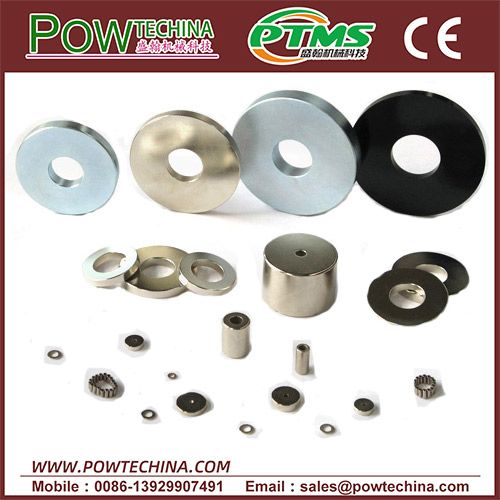
NdFeB Magnets
NdFeB Magnet
NdFeB Magnet by PTMS (Foshan Powtech). NdFeB rare-earth permanent magnets as used in PTMS magnetic systems.
- Free 5–10 kg sample test before you order, report in 5 days
- 24-hour burn-in test on every unit before shipment
- Installation guidance and remote support for overseas buyers
Specifications
Detailed technical parameters for the NdFeB Magnet were not published on the original PTMS website; contact us for the current datasheet. NdFeB rare-earth permanent magnets as used in PTMS magnetic systems.
| Parameter | Value |
|---|---|
| Magnetic field strength | Contact us for specs |
| Capacity / throughput | Contact us for specs |
| Coil or motor power | Contact us for specs |
| Input voltage | Contact us for specs |
| Cooling method | Contact us for specs |
| Dimensions & weight | Contact us for specs |
Specifications for this item are not yet published. Contact us for specs. We configure each machine for your material after a free sample test.
Product details
Overview of permanent magnet steel
Its atomic structure is special, and the atom itself has magnetic moment. In general, these mineral molecules are arranged in disorder, and the magnetic regions interact with each other.
When the direction of molecular alignment is consistent with external force, such as magnetic field, magnetism appears, that is commonly known as magnets. Iron, cobalt and nickel are commonly used magnets.
Material. Basically, the magnet is divided into permanent magnet and soft magnet. Permanent magnet is coupled with strong magnetic force to make the magnetic material spin and electron angular momentum in a fixed direction.
The soft magnetic current is added, and the current is removed, and the soft iron will slowly lose magnetism. Magnet is only a generic term, it refers to magnetic, practical.
The composition does not necessarily contain iron. The iron of pure metal state has no permanent magnetism itself, and only the magnet near the permanent magnet induces magnetism.
A long magnet adds other impurities such as carbon to stabilize magnetism, but this reduces the freedom of the electrons and makes it difficult to conduct electricity.
When the current passes, the bulb does not shine. Iron is a common magnetic element, but many other elements have stronger magnetism, such as powerful magnets.
It is a mixture of neodymium, iron, boron and so on.
The materials used for manufacturing permanent magnets must have wide and long hysteresis loops. In this way, when the external magnetic field is zero, it can still be compared.
Strong magnetization; if we want to change the magnetization to zero, we need to impose a stronger external magnetic field.
Diamagnetic force is the measurement of permanent magnetism of permanent magnetic materials to resist magnetic and non-magnetic interference.