Key takeaways
- Brazil is a major industrial-minerals producer. In 2024 the USGS ranked it second worldwide for silicon metal (about 4% of world output) and third for talc and pyrophyllite (about 9%), vermiculite (about 11%) and natural graphite (about 4%). The same yearbook reports 1,039,552 t of beneficiated kaolin, 773,458 t of beneficiated feldspar, 410,027 t of beneficiated bentonite and 279,577 t of beneficiated talc and pyrophyllite.[1]
- Paper-coating kaolin is concentrated in the eastern Amazon: the CADAM (KaMin) Morro do Filipe mine in Amapá, with a plant at Munguba, Pará, and the Imerys Rio Capim operation (mine at Ipixuna and plant at Barcarena, Pará). The Serviço Geológico do Brasil (SGB/CPRM) first recorded a thick white kaolin layer on the Capim River in 1971.[1][3] Brazil was also the leading source of U.S. clay imports in 2020–23 (about 62%).[2]
- Feldspar for ceramics and glass is produced from pegmatites and related rocks in several states, including Minas Gerais, Paraná, São Paulo, Santa Catarina, Paraíba and Rio Grande do Norte. In a Pedra Lavrada (Paraíba) study, the rock averaged 1.25% Fe2O3; porcelain-tile buyers often specify below 0.15%, and dry magnetic separation reached 0.147% Fe2O3 on one well-liberated size fraction.[6][7]
- Use wet slurry electromagnetic separators for Amazon kaolin plants, wet-milled feldspar and ceramic slip or glaze. Use dry powder electromagnetic separators (PT3A160, PT20A600, PT25A600, PT1000) for dry-milled feldspar and quartz powder, bentonite and talc. Results depend on the ore. To check a deposit, send PTMS 5–10 kg for a free test; the report comes back within 5 days of receipt.
Brazil’s non-metallic mineral industry at a glance
Brazil is widely known for iron ore, niobium and bauxite, but it also supplies industrial minerals that ceramics, glass, paper, foundry and silicon-metal plants buy for colour, flux and chemical purity. The USGS Minerals Yearbook chapter for 2024 (tables compiled through 13 May 2026) lists Brazil as the world’s second-ranked producer of silicon metal and the third-ranked producer of talc and pyrophyllite, vermiculite and crystalline flake graphite. Reported 2024 output included 1,039,552 metric tons of beneficiated kaolin, 773,458 t of beneficiated (marketable) feldspar and 822,651 t of crude feldspar, 410,027 t of beneficiated bentonite, 279,577 t of beneficiated talc and related pyrophyllite (368,925 t crude), 6,577 t of mica, an estimated 190,000 t of silicon metal, 64,588 t of flake graphite concentrates and 55,019 t of vermiculite concentrates.[1]
Two demand centres matter for iron removal. First, export paper-coating kaolin from Pará and Amapá, where brightness is reduced by hematite and goethite and where the United States has long been an important destination—Brazil supplied about 62% of U.S. clay imports in 2020–23.[2][4][5] Second, Brazil’s domestic ceramic-tile and glass industry, which consumes feldspar, kaolin, quartz and talc and, as a 2013 review notes, is also a significant exporter of ceramic tiles.[7] In both cases, Fe2O3 and other ferromagnetic impurities decide whether a lot meets a coating, porcelain-tile or glass specification. That is the commercial case for electromagnetic separation on Brazilian lines.
| Mineral | Main regions and deposits (as named in sources) | Main industrial uses | Sources |
|---|---|---|---|
| Kaolin | Eastern Amazon: CADAM Morro do Filipe mine (Amapá) and Munguba plant (Pará); Imerys Rio Capim mine at Ipixuna and plants at Barcarena (Pará). Capim kaolin is hosted in the Ipixuna Formation | Paper coating (principal use of Amazon kaolin), ceramics, fillers | [1] [3] [4] [5] |
| Feldspar (K and Na) | Pegmatite and related deposits in Minas Gerais (including the AMG Volta Grande/Mibra mine at Nazareno), Paraná, São Paulo, Santa Catarina, Paraíba (including Pedra Lavrada) and Rio Grande do Norte (Borborema–Seridó province) | Ceramic body and glaze, porcelain tile, glass, whiteware | [1] [6] [7] |
| Quartz / silica | Rima Group quartz mine at Bocaiúva, Minas Gerais (USGS-listed capacity 250,000 t/yr). Quartz is also recovered from Iron Quadrangle iron-ore tailings and as a pegmatite co-product | Silicon metal, glass, foundry, ceramics, engineered stone; high-purity grades only after further purification | [1] [8] [10] |
| Bentonite | Main operating deposits historically centred on Boa Vista, Paraíba (including the Juá mine); other deposits at Vitória da Conquista, Bahia, and reserves also reported in Paraná | Iron-ore pelletizing, foundry, drilling fluids, oils, construction and other industrial uses | [1] [9] |
| Talc and pyrophyllite | USGS ranks Brazil third worldwide (about 9% of world output). 2024 production: 279,577 t beneficiated, 368,925 t crude | Ceramics, paint, plastics, paper, cosmetics and other fillers | [1] |
| Mica, vermiculite, graphite | Mica 6,577 t in 2024, often a pegmatite co-product. Vermiculite third worldwide (about 11%); a USGS-listed plant is at São Luís de Montes Belos, Goiás. Graphite third worldwide; mines include Maiquinique and Santa Cruz in Bahia | Electrical and thermal insulation, soil conditioners, refractories, battery materials (graphite) | [1] [7] |
Mineral by mineral: quality, and why iron is the problem
Kaolin
The Capim River kaolin district, in northeastern Pará, is one of the world’s major kaolin deposits. SGB/CPRM identified a thick white kaolin layer along the river in 1971, about 270 km from Belém. A 1974 exploration report cited by SGB quoted 566.8 million tonnes of inferred resource; a later economic evaluation used in SGB’s 2024 technical presentation reports 792.15 million tonnes of inferred resource (soft and sandy kaolin), with an average raw whiteness index of 79.73% and a mineral inventory selected at a brightness index of 84.0% or higher.[3] Those figures describe SGB’s own Capim project blocks, not the privately operated Imerys mine, but they show the scale and the brightness criteria used in the district.
Geologically, the ore developed on Late Cretaceous to early Tertiary sandy–clayey sediments of the Ipixuna Formation. A representative profile has been divided into six facies (sand kaolin, soft kaolin, lower transition, ferruginous crust, upper transition and flint kaolin). Lateritic ferruginization and deferruginization created these contrasts: kaolinite dominates the soft ore, while hematite and goethite dominate the transition facies and the ferruginous crust, where Fe2O3 is the principal oxide. Accessory heavy minerals reported in all facies include zircon, tourmaline, rutile, staurolite and kyanite.[4]
On the operating Ipixuna (Capim) deposit, a mineralogical study of beneficiation showed that the principal pigmenting minerals are hematite and goethite. Total iron and titanium both fall during processing; titanium is reduced mainly by removal of anatase during particle-size fractionation and dithionite bleaching. Importantly for magnetic separation, the iron left in the final coating product was structurally bound in kaolinite, and remnant titanium was present both in the kaolinite structure and as residual anatase.[5] In other words, free iron oxides can be targeted with a high-gradient magnetic separator, but lattice iron and non-magnetic anatase will not be removed by magnets alone. Chemical bleaching or flotation may still be required, depending on the ore.
USGS lists two large Amazon operations: CADAM S.A. (KaMin LLC), Morro do Filipe mine in Amapá with a 500,000 t/yr shared capacity and a beneficiation port and plant at Munguba, Pará; and Imerys Rio Capim Caulim S.A., with a mine at Ipixuna and processing at Barcarena, Pará, at an estimated 2,000,000 t/yr shared capacity.[1]
Potassium and sodium feldspar
Brazilian ceramic and glass plants use potassic and sodic feldspar as a flux. A review of Brazilian feldspar notes that the main consuming industries are ceramics and glass, and that Brazil is a significant exporter of ceramic tiles. Commercial sources include pegmatites and, in some districts, feldspathic rock that is crushed and beneficiated. Producing states named in that review include Paraná, Minas Gerais, São Paulo, Santa Catarina, Paraíba and Rio Grande do Norte.[7] USGS lists the AMG Mineração Volta Grande (Mibra) mine at Nazareno, Minas Gerais, with an estimated 180,000 t/yr feldspar-ore capacity.[1]
In the Borborema–Seridó pegmatite province of Paraíba and Rio Grande do Norte, pegmatites hosted mainly in Seridó Group mica schists, quartzites and gneisses contain quartz, feldspar, mica, kaolin and, locally, beryl, tourmaline and other accessory minerals. The same review states that feldspar beneficiation is generally based on flotation and magnetic separation to remove accessories such as mica, garnet and ilmenite, with quartz often taken as a co-product.[7]
A 2022 UFCG dissertation on a feldspar-rich rock from Pedra Lavrada, Paraíba, gives a clear iron-removal case. The rock contained albite, orthoclase and microcline, plus quartz, with magnetite and hornblende as the main iron-bearing minerals. Average Fe2O3 was 1.25%, with the −0.6+0.3 mm and −0.3+0.15 mm fractions as high as 1.621% and 1.924%. Porcelain-tile and whiteware specifications often require Fe2O3 below 0.15%. Dry magnetic separation of the −0.3+0.15 mm fraction at low roller speed produced a non-magnetic product with 0.147% Fe2O3 (a 76.81% reduction relative to the feed of that test), meeting the porcelain-tile chemical standard cited by the author. Other operating conditions left 0.285–0.3% Fe2O3 in the non-magnetic fraction—slightly above the porcelain-tile limit, but described as suitable for less demanding ceramics or glass. Liberation of the magnetic phases improved below 0.3 mm, which is why grind size matters as much as field strength.[6] These are published results on one sample, not a guarantee for every Brazilian pegmatite.
Quartz, silica and silicon-metal feed
Brazil is a second-ranked world producer of silicon metal (about 4% of world output), with estimated 2024 production of 190,000 t.[1] The USGS facilities table lists a Rima Group quartz mine at Bocaiúva, Minas Gerais, with an estimated capacity of 250,000 t/yr.[1] Silicon metal and ferrosilicon need low-iron quartz or quartzite; the United States, for example, sourced about 38% of its silicon-metal imports in 2020–23 from Brazil.[10]
A second, growing quartz stream is the Iron Quadrangle of Minas Gerais. More than 80 million tonnes per year of iron-ore tailings have been generated there in recent decades; deslimed tailings are typically close to 90% SiO2. In a 2025 study, quartz was the main mineral and iron oxides the second, with about 83% of the Fe-oxides as free particles and 17% associated with quartz. Adding a high-intensity vertical magnetic-separation stage raised the SiO2 grade to 97.46%. A later flotation step produced premium quartz at 99.20–99.46% SiO2, still with 0.79–0.96% Fe2O3 and less than 0.260% other impurities—grades the authors judged suitable for glass, silicates, foundry and engineered stone, but not for high-purity quartz (they cite a typical high-purity limit of 50 ppm total impurities, including Fe below 3 ppm). Fine inclusions of iron oxides prevented a higher SiO2 grade; acid leaching was suggested as a further step.[8] Magnetic separation is therefore useful, and clearly not sufficient on its own, when the target is solar or semiconductor silica.
Bentonite, talc and other minerals
USGS reports 410,027 t of beneficiated bentonite in 2024, up from 368,845 t in 2023.[1] A Ministry of Mines and Energy profile (prepared for the 2010–2030 mineral plan) locates the main operating deposits in Boa Vista, Paraíba, including a schematic of the Juá mine, and notes other deposits at Vitória da Conquista, Bahia, with additional reserves reported in Paraná. Brazilian bentonite is used in iron-ore pelletizing, foundry, oil and gas drilling, greases, fertilizers and other industrial applications. The same profile notes that some domestic grades are silica-rich and that quality, not only tonnage, limits substitution for imported clay in certain pelletizing duties.[9] Dark, iron-bearing grains and tramp metal in milled bentonite are the particles an electromagnetic powder separator can target; iron in the smectite lattice will remain.
For talc and pyrophyllite, the USGS 2024 chapter ranks Brazil third in the world (about 9% of output), with 279,577 t beneficiated and 368,925 t crude.[1] Ceramic and filler grades are judged on colour and Fe2O3. Mica (6,577 t in 2024) is often a pegmatite co-product in the same districts as feldspar and quartz.[1][7] Graphite (64,588 t of flake concentrate; third worldwide) and vermiculite (55,019 t; third worldwide, with a USGS-listed plant in Goiás) complete the industrial-mineral list; they are mentioned here for context, not as the main feed for slurry iron removers.[1]
Why iron and ferromagnetic impurities hurt quality
- Paper brightness. On Capim kaolin, hematite and goethite are the main pigmenting minerals. Coating grades are sold on brightness and shade; free iron oxides must be reduced, while structural iron stays in the product.[5]
- Fired colour and black spots. Brazilian feldspar and kaolin go into tile, sanitaryware and porcelain. The Pedra Lavrada study cites a porcelain-tile Fe2O3 limit below 0.15%. Metallic iron particles also cause black spots after firing.[6]
- Glass and silicon-metal colour or purity. Iron tints glass green and is a penalty element in quartz for silicon metal and in any attempt to move Iron Quadrangle quartz toward higher-purity uses.[8][10]
- Export price. Amazon kaolin already moves into the U.S. and other coating markets.[2] A lower-iron feldspar, quartz or ceramic slip can open better-paying domestic and export lots; a failed Fe2O3 or brightness test closes them.
What to expect from electromagnetic separation: typical, ore-dependent ranges
Magnetic separation removes only the iron that magnets can capture, and its effect depends on how that iron occurs:
- Usually well removed: liberated magnetite and hematite, goethite or limonite; iron-bearing silicates such as hornblende, biotite, tourmaline and garnet; wear iron from crushers, mills and pipes.
- Removed only partly: thin iron coatings and iron locked inside other grains (about 17% of Fe-oxides were associated with quartz in the Iron Quadrangle tailings study).[8]
- Not removed: iron inside the crystal lattice of kaolinite, smectite or talc; non-magnetic minerals such as rutile and anatase.[5]
The table gives indicative ranges from high-gradient magnetic separation practice and the published Brazilian tests cited above. They are not guarantees. Results vary by ore, and each case must be confirmed with a pilot test report on your own material.
| Material | What the separator can capture | Typical outcome (indicative) | Main limits |
|---|---|---|---|
| Na/K feldspar (wet or dry) | Magnetite, hornblende, mica, garnet, ilmenite, free iron oxides, tramp iron | Fe2O3 typically about 30–70% lower where iron minerals are liberated. A dry-roll test on Pedra Lavrada feldspar (–0.3+0.15 mm, low roller speed) reached 0.147% Fe2O3, a 76.81% reduction versus that test feed[6] | Locked grains and coarser fractions respond less (other conditions in the same study left 0.285–0.3% Fe2O3). Grind and liberation must be checked first |
| Kaolin (wet slurry) | Free hematite, goethite, magnetite, iron-bearing heavy minerals, tramp iron | Fe2O3 typically about 20–60% lower than the feed where free iron dominates; a brightness gain of a few points is possible on some ores | Structural iron in kaolinite and residual anatase are not removed by magnets; coating plants may still use size fractionation and chemical bleaching[5] |
| Silica / quartz (wet or dry) | Free iron oxides, heavy minerals, crusher iron | Fe2O3 typically about 20–50% lower, more where iron is free. On Iron Quadrangle deslimed tailings, high-intensity vertical magnetic separation raised SiO2 to 97.46%[8] | Inclusions and locked Fe-oxides remain; the same study still had 0.79–0.96% Fe2O3 after flotation, so leaching may be needed for high-purity quartz |
| Bentonite and talc powder (dry) | Iron-bearing grains, tramp iron, magnetic dark specks | Cleaner product with fewer dark specks; colour gains usually modest | Lattice iron stays in the product |
| Ceramic slip and glaze (wet) | Free iron and fine magnetic particles from raw materials and equipment | Typically fewer black spots after firing and a higher first-quality yield | Iron dissolved in frits or locked in raw materials is not affected |
How wet slurry and dry powder electromagnetic separators upgrade Brazilian kaolin, feldspar and quartz
How an electromagnetic slurry separator works
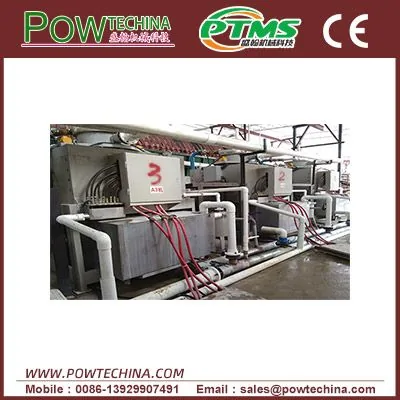
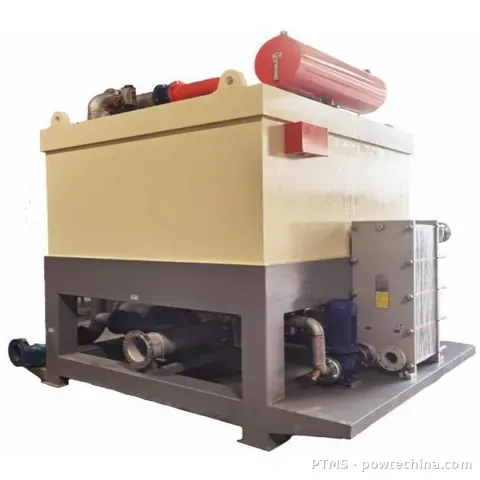
A PTMS electromagnetic slurry separator is a high-gradient magnetic separator (HGMS). A water- or oil-cooled copper coil generates a background field; a matrix of steel wool, rods or grids placed in the cavity multiplies the local gradient so that weakly magnetic particles—hematite, goethite, biotite, hornblende, garnet—are held while the non-magnetic kaolin, feldspar or quartz slurry passes through. At the end of the cycle the field is switched off and the matrix is flushed. Dry powder machines use the same electromagnetic principle on a free-flowing powder, without process water.[11]
Process flow for Brazilian (Amazon) kaolin
Capim and Amapá coating kaolins are already wet-processed: dispersion, sand removal, centrifugation or hydrocyclones for particle-size control, and often chemical bleaching.[5] A wet electromagnetic slurry separator is inserted after desanding and before, or sometimes after, bleaching, so that liberated hematite and goethite are taken out before they consume bleach or stain the coating grade. A typical arrangement is:
- Dispersion and grit/sand removal (quartz in the sandy facies is substantial).[4]
- Particle-size classification (coating vs filler cuts).
- High-gradient wet electromagnetic separation (fine steel-wool or kaolin matrix) to capture free hematite, goethite and tramp iron.
- Where needed, chemical bleaching and dewatering. Magnets do not replace bleaching when structural iron remains.[5]
Ceramic kaolin and slip in the South and Southeast, where the ore may be coarser or more iron-stained than Amazon coating clay, follow a similar wet path, with the separator placed on the washed slurry or on the mill-house slip.
Process flow for Brazilian feldspar (dry and wet lines)
Pegmatite feldspar in Paraíba, Rio Grande do Norte and Minas Gerais is often crushed and screened, then either dry-separated or milled and treated wet (flotation plus magnets), as described for Borborema–Seridó ores.[7] The Pedra Lavrada work shows why a dry electromagnetic or roll stage can be enough when magnetite and hornblende are liberated around 0.3 mm, and why a coarser feed underperforms.[6]
- Crushing and screening; remove coarse waste rock.
- If mica, garnet or ilmenite remain, flotation and/or magnetic separation, as already practised in the Northeast.[7]
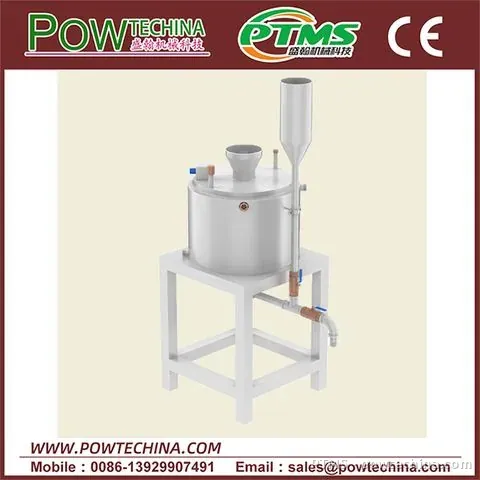
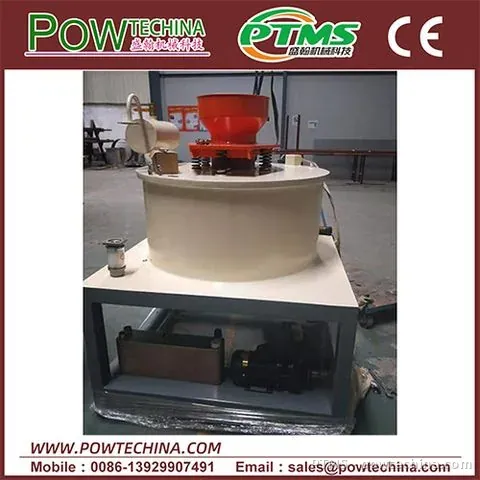
- Dry powder electromagnetic separation (PT3A160, PT20A600, PT25A600 or PT1000) on dry-milled powder; or a wet slurry electromagnetic separator on wet-milled or flotation product.
- Confirm Fe2O3 (and, where specified, TiO2 and fired colour) against the porcelain-tile, glaze or glass limit. Non-magnetic titanium minerals need a different step.
Process flow for quartz and silica
For mined quartz or quartzite (for example feed to silicon-metal furnaces) and for glass sand, the dry or wet electromagnetic stage is usually placed after crushing and sizing, to pull tramp iron and liberated iron oxides. For Iron Quadrangle tailings, the published route was desliming, high-intensity magnetic separation to lift SiO2 toward 97%, then flotation; leaching only if a high-purity target remains out of reach.[8] PTMS can supply the electromagnetic stage; it does not replace flotation or leaching when inclusions set the floor on Fe2O3.
Bentonite, talc and ceramic slip or glaze
Dry-milled bentonite from Boa Vista and talc or pyrophyllite powders are usually treated on a dry electromagnetic powder separator, to reduce dark magnetic specks and tramp iron without adding water that would then have to be dried off.[9] Ceramic tile and sanitaryware plants—large feldspar and kaolin consumers in Brazil[7]—can place a wet electromagnetic separator on slip or glaze to catch fine iron from raw materials and from mill and pipeline wear, which is a common cause of black spots after firing.
Wet or dry: how to choose
| Question | Wet slurry separator | Dry powder separator |
|---|---|---|
| What form is your material in? | Already a slurry: Amazon kaolin washing plants, wet-milled feldspar, flotation feed or product, ceramic slip and glaze | Dry, free-flowing powder or granules: dry-milled feldspar or quartz, bentonite, talc, dried glass sand |
| Particle size | Fine slurries; as a published PTMS reference, the 7A160 Wet Magnet is rated for slurry below 40 mesh | Fine powder in electromagnetic powder machines; 0.1–10 mm granules on belt-type roller separators |
| Fine, weakly magnetic iron | Best choice: particles are dispersed and the high-gradient matrix catches very fine hematite and goethite in kaolin | Effective on dry powder, but material must stay dry and free-flowing. The Pedra Lavrada feldspar test is an example of a successful dry route when liberation is adequate[6] |
| Water and drying | Needs process and flushing water; product must be dewatered. This already fits Amazon kaolin plants | No water and no extra drying step, which suits dry feldspar grinding plants in the Northeast and Southeast |
Choosing field strength, cooling and matrix
- Field strength. Tramp iron is caught at low field. Weakly magnetic minerals such as hematite, goethite, hornblende, biotite, tourmaline and garnet need a high-intensity field plus a high-gradient matrix. Published PTMS figures:
- A65K750J (750 mm cavity) and A40K530J (530 mm cavity) slurry iron removers: 0–20,000 GS, adjustable
- 7A160 Wet Magnet: about 30,000 GS theoretical
- Electromagnetic Dry Powder Magnetic Separator Series: PT20A600 published at 2.5 T, 600 mm cavity, water + oil dual cooling, about 2–4 t/h; PT3A160, PT25A600 and PT1000 configured per ore after testing
- Dry Magnet 3A160 for smaller dry powder lines
- Cooling. Continuous high-field operation heats the coil, and hot, humid conditions in Pará, Amapá and the Northeast make stable cooling important. The A65K750J is oil-cooled, the A40K530J uses combined oil and water cooling, and water-cooled designs such as the 750 Water Cooling Wet Type Magnet and the Electromagnetic Slurry Magnetic Separator Type 1000 (PT1000 class) keep the field stable over long shifts.
- Matrix. Fine kaolin and feldspar slurries generally use fine steel wool matrix or a dedicated kaolin and feldspar matrix. Coarser feeds use grid matrices. Screening ahead of the separator protects the matrix.
- Capacity. Throughput depends on solids content, particle size and target iron level. PTMS confirms the model size after the sample test rather than quoting a generic t/h figure.
PTMS models to shortlist for Brazilian plants
- Amazon and ceramic kaolin slurry: A65K750J, A40K530J, the Kaolin Water-Cooled Electromagnetic Automatic Magnetic Separator, Model 1000, and the Electromagnetic Slurry Magnetic Separator Series.
- Potassium and sodium feldspar: Potassium Sodium Feldspar Magnetic Separator and the 750 water-cooled model for wet lines; dry electromagnetic models PT3A160, PT20A600, PT25A600 and PT1000 for dry powder lines (dry powder series, 3A160).
- Quartz and silica: Dry Separator for Quartz Powder (Double Discharge), the dry electromagnetic PT models above, and the Fully Automatic 3-Layer Belt Magnetic Separator for granules.
- Bentonite and talc powder: Electromagnetic Bentonite Powder Magnetic Separator and the dry powder PT series.
- Ceramic glaze and slip: Electromagnetic Magnetic Separator for Ceramic Glaze (WS series, 2–3.5 T).
Material guides: kaolin, feldspar, quartz sand and quartz stone, ceramics.
Test your Brazilian ore free before you invest
Amazon kaolin, northeastern pegmatite feldspar and Iron Quadrangle quartz do not behave the same, and grades can change from pit to pit. A measured result on your own material is the only reliable basis for choosing a separator. PTMS tests your material free of charge:
- Send 5–10 kg of kaolin, feldspar, quartz sand or powder, bentonite, talc or ceramic slurry or powder to our factory in Foshan, Guangdong, China.
- Within 5 days of receiving the sample, we send a test report with before-and-after iron content (and whiteness where relevant).
- The report includes a recommended wet or dry model (including PT3A160, PT20A600, PT25A600 or PT1000 where appropriate), field strength and process flow.
Request a free sample test WhatsApp +86 139 2990 7491
You can also email sales@powtechina.com. Please include your material, particle size, capacity (t/h or m³/h), solids content for slurries, current Fe2O3 and TiO2 or whiteness, and your target.
Sources
- U.S. Geological Survey, National Minerals Information Center (Yolanda Fong-Sam). The Mineral Industry of Brazil in 2024 (Minerals Yearbook, Vol. III). Production table, world rankings and facilities (data available through 13 May 2026). https://pubs.usgs.gov/myb/vol3/2024/myb3-2024-brazil.pdf
- U.S. Geological Survey. Mineral Commodity Summaries 2025 — Clays (including U.S. clay import sources, 2020–23). https://pubs.usgs.gov/periodicals/mcs2025/mcs2025-clays.pdf
- Serviço Geológico do Brasil (SGB/CPRM), Mineral Economics and Exploration Division. Rio Capim Kaolin Deposit – Pará State. Technical presentation, October 2024 (history, geology, inferred resources and whiteness). https://www.sgb.gov.br/documents/d/guest/rio_capim_kaolin_deposit_technical_presentation_oct2024-pdf
- Sousa, D.J.L., Varajão, A.F.D.C., Yvon, J., Da Costa, G.M. (2006). Mineralogical and geochemical aspects of the Capim River kaolin, eastern Brazilian Amazon. Journal of Geochemical Exploration 88 (and related 2005/2006 Capim facies study). DOI: 10.1016/j.gexplo.2005.08.068. https://doi.org/10.1016/j.gexplo.2005.08.068
- Scorzelli, R.B., Bertolino, L.C., Luz, A.B., Duttine, M., Silva, F.A.N.G., Munayco, P. (2008). Variation of mineralogy during the beneficiation of Capim kaolin from Pará, Brazil. Clay Minerals 43(3): 351–. DOI: 10.1180/claymin.2008.043.3.04. https://doi.org/10.1180/claymin.2008.043.3.04
- Ferreira, D.D. de A. (2022). Estudos de caracterização química e mineralógica para definição de parâmetros para separação magnética, visando a redução de Fe2O3 em rocha rica em feldspatos extraída em Pedra Lavrada – PB. M.Sc. dissertation, Universidade Federal de Campina Grande (UFCG). https://dspace.sti.ufcg.edu.br/handle/riufcg/28848
- Lira, H.L., Neves, G.A. (2013). Feldspatos: conceitos, estrutura cristalina, propriedades físicas, origem e ocorrências, aplicações, reservas e produção. Revista Eletrônica de Materiais e Processos 8(3): 110–117. https://remap.revistas.ufcg.edu.br/index.php/REMAP/article/download/342/284
- Lima, N.P., Lopes, G., Resende, L., Faustino, L. (2025). High grade quartz products from magnetic separation and flotation of iron ore tailings. Tecnologia em Metalurgia, Materiais e Mineração 22: e20253157. DOI: 10.4322/2176-1523.20253157. https://doi.org/10.4322/2176-1523.20253157
- Ministério de Minas e Energia (MME) / SGM, Projeto ESTAL. Produto 28, Relatório Técnico 43: Perfil da bentonita (consultant José Mário Coelho). August 2009. Deposit locations in Boa Vista (Paraíba) and Vitória da Conquista (Bahia). https://www.gov.br/mme/pt-br/assuntos/secretarias/geologia-mineracao-e-transformacao-mineral/relatorios-de-apoio-ao-pnm-2030-projeto-estal-1/a-mineracao-brasileira/documentos/p28_rt43_perfil_da_bentonita.pdf
- U.S. Geological Survey. Mineral Commodity Summaries 2025 — Silicon (silicon-metal production and U.S. import sources, 2020–23). https://pubs.usgs.gov/periodicals/mcs2025/mcs2025-silicon.pdf
- Svoboda, J., Fujita, T. (2003). Recent developments in magnetic methods of material separation. Minerals Engineering 16(9): 785–792. https://doi.org/10.1016/S0892-6875(03)00212-7