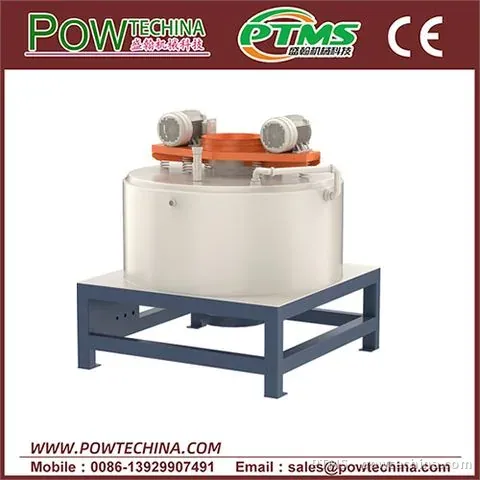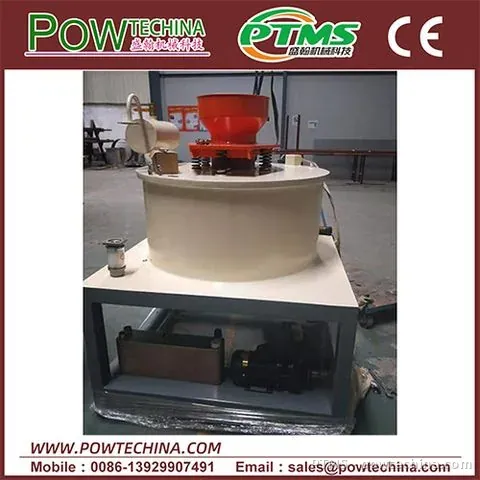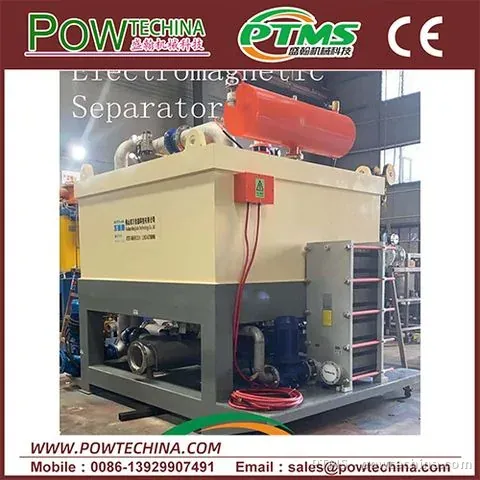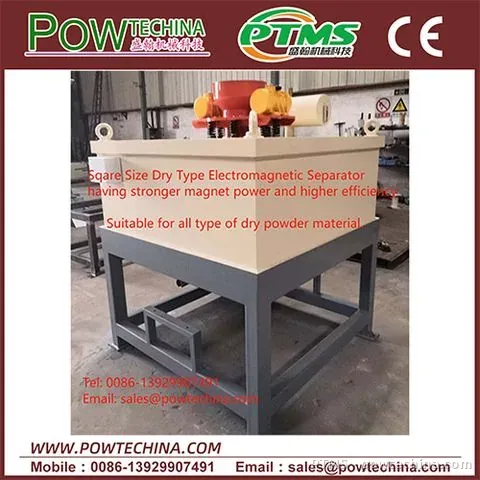
Electromagnetic Separators
Electromagnetic Slurry Magnetic Separator Series — Price & Quotation
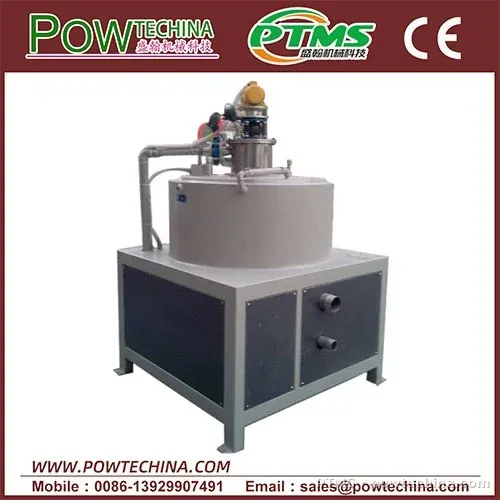
An electromagnetic slurry magnetic separator from PTMS (Foshan Powtech) is a wet electromagnetic separator that removes fine iron and weakly magnetic impurities from kaolin, feldspar, quartz and ceramic slurry. A high-gradient matrix inside a water- or oil-cooled coil captures contaminants, then flushes them out automatically between feed cycles.
- Free 5–10 kg sample test before you order, report in 5 days
- 24-hour burn-in test on every unit before shipment
- Installation guidance and remote support for overseas buyers
Request a quote Free sample test
Applications
What is an electromagnetic slurry magnetic separator?
An electromagnetic slurry magnetic separator is a wet high-gradient magnetic separator (wet HGMS) that pumps mineral or ceramic slurry through an energized coil packed with a steel matrix. Fine iron and weakly magnetic particles stick to the matrix; the coil is then switched off and flushed, so iron leaves automatically while clean slurry continues down the line.
Wet electromagnetic separator vs. permanent magnet for slurry
A wet electromagnetic separator lets you adjust field strength and release captured iron on a timed cycle, which suits continuous kaolin, feldspar, quartz and glaze slurry lines. Permanent magnetic rods or grates are simpler but must be cleaned by hand and give a fixed field. See all wet / slurry magnetic separators, the kaolin and ceramic slurry application pages, or the guide magnetic separators for slurry. A short before-and-after slurry video shows the process.
Specifications
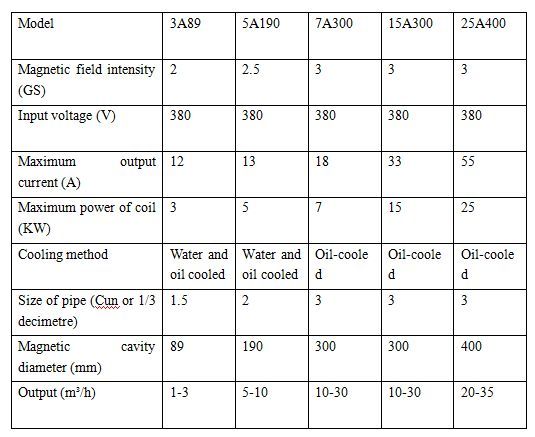
Full technical parameters of the PTMS-H-B13K89J, the 89 mm small-capacity / lab-scale model of our stainless steel electromagnetic slurry separator range. Other sizes in the series are configured per project; contact us for their datasheets.
| Parameter | Value |
|---|---|
| Model | PTMS-H-B13K89J (stainless steel electromagnetic slurry iron remover) |
| Theoretical magnetic field | 0–15,000 GS |
| Input voltage | 380 V |
| Maximum current | 0–35 A (adjustable) |
| Rated excitation power | 0–13 kW (adjustable) |
| Cooling | Water + oil dual cooling (forced oil circulation + water cooling); coil insulation class E; working temperature ≤50 °C with cooling water ≤30 °C |
| Magnetic chamber diameter | 89 mm |
| Capacity | ≥500 kg/h |
| Slurry solid content | 40–60% |
| Feed / iron discharge / slurry outlet / slurry return / flushing water pipes | φ38, 304 stainless steel, polished |
| Cooling water pipe | DN25 |
| Overall dimensions | 1380 × 1380 × 1590 mm |
| Main unit weight | approx. 1.5 t |
| Magnetic matrix | Special high-performance magnetic stainless steel |
| Feed mode | Bottom feed, top discharge (counter-current) |
| Water pump | MDZ-10-0.75KW, head 15 m, flow 4 m³/h |
| Electrical components | 7-inch touch screen (MCGS / Kunlun Tongtai); Siemens S7-200 PLC; three-phase rectifier magnetizer 60 A JKTYQ-SZ-30T (Lanjun); Schneider control transformer BK-250VA; Schneider contactor LC1N0910M5N; Schneider relays RV2S-D24; air breaker NXB-125 3P-80A; power supply LRS-100-24 100 W; solenoid valve 4V210-8 DC24V |
| Control | Manual + automatic; automatic cycle of excitation, feeding, diverter valve and iron discharge; overload / leakage protection; feed, discharge and flushing times set on the touch screen; oil temperature monitoring with alarm and automatic stop; fault self-diagnosis; dust-proof double-door cabinet |
| Contamination control | No copper or zinc on exposed parts; design prevents oil drip and rust contamination |
Working principle
Slurry is fed through the chamber with the magnet energized. Feeding then stops, the residual slurry returns to the tank, the coil is de-energized, and the iron discharge valve opens so the captured iron is flushed out with water.
Third-party Lab Test: Before vs After Iron Removal
One pilot sample—Indian high-alumina raw ore on a PTMS electromagnetic slurry separator. Fe₂O₃ fell from 6.03% to 2.33% (about 61% lower); Al₂O₃ rose from 50.17% to 53.31% on the same assay. The oxide table below is this sample only. Results vary by ore; we do not promise titanium reduction. The lab reports do not state which machine size was used.
| Item | Before: raw ore (H2026061929) | After iron removal (H2026061930) |
|---|---|---|
| Loss on ignition (LOI) | 26.53 | 27.43 |
| Al₂O₃ | 50.17 | 53.31 |
| SiO₂ | 11.84 | 12.73 |
| Fe₂O₃ | 6.03 | 2.33 |
| CaO | 0.06 | 0.06 |
| MgO | 0.11 | 0.09 |
| K₂O | 0.10 | 0.12 |
| Na₂O | 0.15 | 0.15 |
| TiO₂ | 4.71 | 3.47 |
- Material: Indian high-alumina raw ore (kaolin / bauxite type)
- Laboratory: Foshan Youbo Ceramic Analysis & Testing Co., Ltd. (independent third party)
- Report nos.: H2026061929 (raw ore, before) and H2026061930 (after iron removal)
- Sample received 19 June 2026, reported 20 June 2026; powder sample approx. 100 g; 25 °C, 68% RH
- Test methods: GB/T 21114-2019 and GB/T 4734-2022
This is one pilot example, not a guaranteed outcome for every ore—especially not a titanium-reduction promise. Your material can be tested free: send 5–10 kg; report within 5 days of receiving samples.
Product details
Product description
It is the fully automatic operation, without any manual operation. The magnetic field intensity is high, and the magnetic field distribution is even, while the magnetic field gradient is high, and the iron removal effect is obvious. The cooling system adopts the external oil-cooled heat dissipation method, which has the good circulation effect, may effectively control the temperature rise, and extends the life span of coil. The break valve adopts the imported materials, while the valve body is sturdy and durable, and no residual slurry will be spilled over after the valve is closed. The iron removal adopts the air ejection and high-pressure water pump flushing method to make the thorough cleaning, without any residue. The meshes are made from the special materials, while there is no residual magnetism after the disconnection of magnetic field, and the iron removal is convenient, efficient, and thorough, without any residue.
Operation process
It is required to connect the power supply unit, open the slurry inlet valve and slurry outlet valve, close the back-slurry valve and iron dumping valve, and open the magnetizer. When all the slurries pass through the slurry iron remover, it is required to close the inlet valve and slurry outlet valve, open the back-slurry valve, and drain the remaining slurries in the iron remover via the back-slurry valve. Then, it is required to disconnect the magnetic field, close the back-slurry valve, and open the iron dumping valve, so as to dump the magnetic substances stuck to the magnetic medium.
Scope of application
The electromagnetic slurry magnetic separator is widely applied to remove the iron powder, micro-iron powder, magnetic substances, and others contained in the glaze slurry of the ceramics, mining industry, chemistry, food and other industries.
Electromagnetic slurry separator price: what decides the cost
PTMS does not publish prices: the price follows the configuration. What sets it:
- Type — wet or dry, electromagnetic or permanent
- Size and field — working cavity and background field for your throughput
- Matrix and cooling — steel mesh or steel wool; water or oil cooling
- Contact parts and automation — stainless parts, flushing valves, PLC
What to send for a quotation
- Material, slurry or dry powder
- Capacity and particle size
- Current and target iron content
- Supply voltage and destination
Get a factory quotation by email Free sample test
We usually reply within 24 hours. Full guide: magnetic separator price.
Electromagnetic slurry separator: FAQ
What materials can a wet electromagnetic separator process?
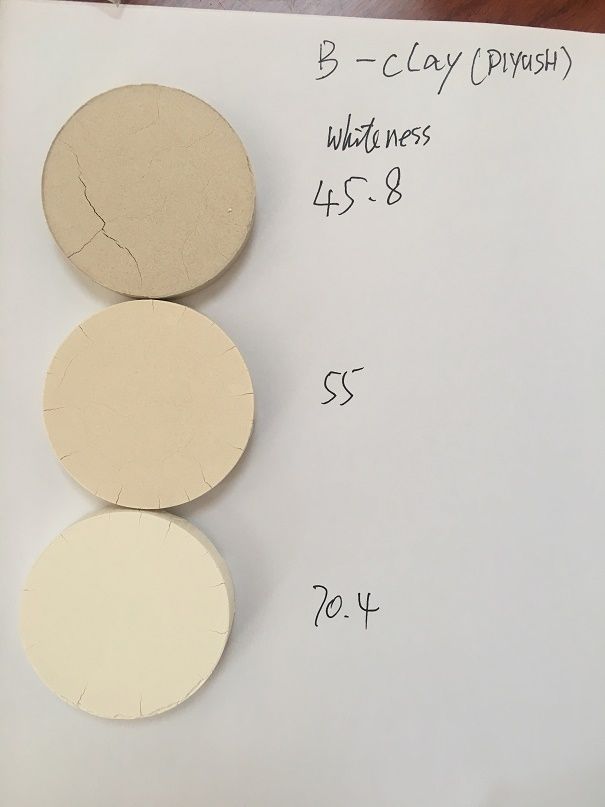
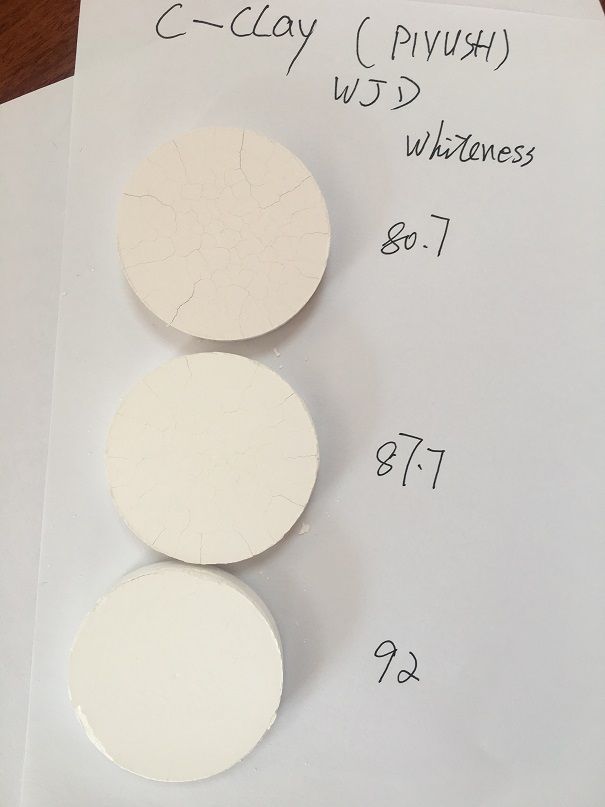
Typical feeds are kaolin, feldspar and quartz slurry, ceramic glaze and slip, and other non-metallic mineral slurries where fine iron lowers whiteness or causes black specks.
What slurry solids content does it accept?
The published table for the PTMS-H-B13K89J lists 40–60% solids. Other sizes are configured per project from your solids content, particle size and throughput.
How much iron will it remove from my material?
Results vary by ore and iron mineralogy, so we do not quote a figure in advance. Send a free 5–10 kg sample for a pilot test; we report within 5 days of receiving it.
Is iron discharge manual?
No. The PLC runs feeding, de-energizing, flushing and iron discharge automatically, with times set on the touch screen.
Is an electromagnetic slurry separator a WHIMS?
Yes. It is a wet high intensity, high-gradient magnetic separator that works in cycles: slurry passes the energised matrix, then the field is switched off and the matrix is flushed. For continuous duty PTMS also builds the vertical ring HGMS.
Can I test my slurry before choosing a model?
Yes. Results vary by ore and slurry, so send 5–10 kg for a free pilot test; the report comes back within 5 days of receiving your sample, and the model is chosen from that result.
What is the price of an electromagnetic slurry magnetic separator?
It depends on cavity size, background field, matrix, cooling, contact parts and automation. PTMS does not publish prices; send your material, capacity and iron target for a factory quotation by email. A free 5–10 kg pilot test, report within 5 days of receiving samples is available.