
Guide
Magnetic Separators for Slurry: Electromagnetic, High-Gradient and Wet Drum
Three machine families remove iron from slurry. This guide compares how they work and gives the sizing figures PTMS has published, so you know what to ask for before you send a sample.
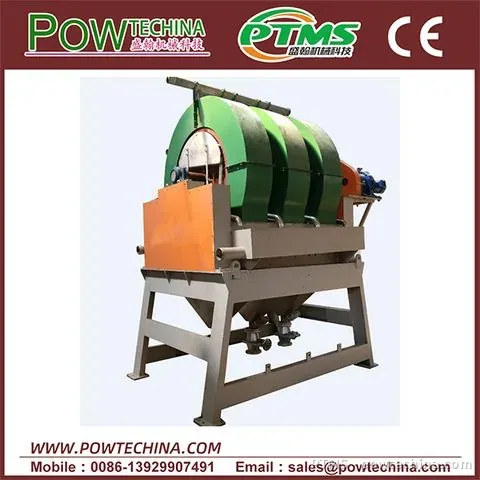
Three ways to clean a slurry
| Electromagnetic slurry separator | Vertical ring HGMS | Wet drum (permanent) | |
|---|---|---|---|
| Operation | Cycles: slurry passes the matrix; valves close, field off, matrix flushed automatically | Continuous: vertical ring keeps rotating; captured material washed out in the reverse direction | Continuous: drum rotates, magnetic minerals flushed into concentrate trough |
| Best for | Fine iron removal from kaolin, feldspar and ceramic glaze slurry | Weakly magnetic minerals in non-metallic ores | Strongly magnetic minerals |
| Field | Powered coil, adjustable, high gradient matrix | High gradient; high-frequency vibration helps stop the medium blocking | Permanent magnet system |
| PTMS | Electromagnetic slurry series | Vertical ring HGMS | Wet drum separators |
How the electromagnetic slurry separator cycle works
Slurry is pumped through a magnetised matrix. Fine iron and weakly magnetic impurities stick to the matrix and clean slurry flows out. Then the slurry valves close, remaining slurry drains back through the return valve, the field is switched off and the matrix is flushed with air ejection and high-pressure water. The matrix has no residual magnetism, so cleaning is fast and complete.
Published sizing figures
- Model names: the last number is the bore (magnetic cavity) diameter in millimetres, e.g. 3A89, 7A190, 11A250, 20A400. Larger models handle more slurry per hour.
- 7A160 Wet Magnet: about 30,000 GS theoretical field, 300 mm magnetic cavity, 10–30 m³/h for slurry below 40 mesh.
- PTMS-H-B13K89J: slurry solid content 40–60%, capacity at least 500 kg/h, water-and-oil dual cooling, working temperature ≤50 °C with cooling water.
- Larger mineral machines: A65K750J (750 mm bore, oil-cooled, 0–65 kW adjustable) and A40K530J (530 mm bore, oil-water dual cooling, 0–40 kW adjustable).
- Ceramic glaze WS series: published maximum coil power from 1.5 kW (WS1.5K160, 220 V) and 3 kW (WS3K89, 380 V) up to 7, 11 and 20 kW (WS20K400, 380 V). Coil power is a maximum rating; actual use depends on field and duty cycle.
Cooling and matrix
Water-cooled and oil-cooled coils keep the field stable in continuous operation; dual cooling is chosen when coil load and duty cycle need more than a single circuit. The matrix is the magnetic medium that catches fine iron, and its type is matched to your slurry: grids for slurry separators, a matrix designed for kaolin and feldspar and a customised steel wool matrix. Matrices are stocked as spare parts.
What to tell us before the quote
Solids content, particle size distribution, throughput (m³/h or t/h), current iron content and target. Coarser feed is usually screened or milled first so the pulp passes the cavity and matrix evenly. Send 5–10 kg for a free 5–10 kg sample test; the report comes back within 5 days of receipt.
Magnetic Separators for Slurry: questions
What is the difference between a vertical ring HGMS and an electromagnetic slurry separator?
A vertical ring high gradient separator works continuously: the ring keeps rotating and captured material is washed out in the reverse direction, with high-frequency vibration to stop the medium blocking. An electromagnetic slurry separator works in cycles: slurry passes a magnetised matrix, then the valves close, the field switches off and the matrix is flushed automatically. The right choice depends on your ore and line.
What slurry solids content suits an electromagnetic slurry separator?
Published reference data for the PTMS-H-B13K89J list a solid content of 40–60% with capacity of at least 500 kg/h. The workable level still depends on particle size, viscosity and target iron level, and PTMS confirms it with a sample test.
What feed particle size can the slurry separator take?
A published reference is the 7A160 Wet Magnet, specified for slurry below about 40 mesh. Coarser feed is usually screened or milled first.
How do I read model numbers like 7A190 or 20A400?
The last number is the bore (magnetic cavity) diameter in millimetres, so larger models handle more slurry per hour.
Water-cooled or oil-cooled?
Both keep the coil temperature stable in continuous operation. Dual water-and-oil cooling is used when the load and duty cycle need more than a single circuit. PTMS recommends the cooling type for your duty cycle and site conditions.
Related guides
Send us your material. We test it free.
Tell us your material, particle size, capacity and target iron level. We usually reply with a matched model and price within 24 hours.