
Guide
Magnetic Separators: Types, Working Principle and How to Choose
A magnetic separator pulls magnetic particles, mostly iron, out of a flow of powder, granules or slurry. This guide explains how the main types work and which one fits your material. It is written by the PTMS engineering team in Foshan, China.
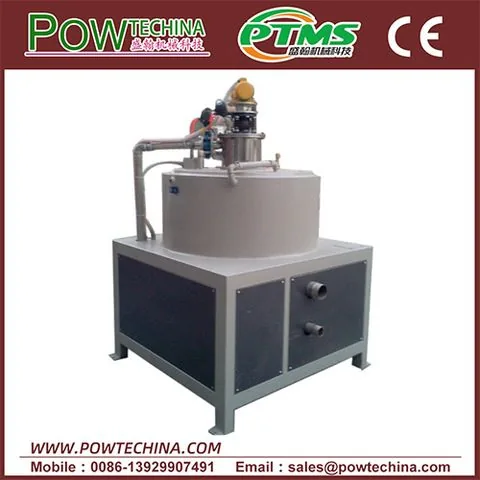
What a magnetic separator does
A magnetic separator holds magnetic material in a magnetic field while non-magnetic material passes through. In industrial minerals and battery materials the job is usually purification: iron and iron-bearing minerals lower whiteness, darken fired ceramics and contaminate powders, so they are captured and discharged. (If you searched for a “magnet seperator”, this is the same machine family.)
Many impurities are only weakly magnetic. Biotite, amphibole and tourmaline in feldspar, and iron oxides, mica and titanium minerals in kaolin, are examples. An ordinary magnet misses them, so the separator needs a strong field and a high field gradient.
The iron separator working principle in three steps
- Magnetise The material passes through a magnetic field. In a high-gradient (HGMS) slurry separator the slurry is pumped through a magnetised matrix.
- Capture Fine iron and weakly magnetic impurities stick to the matrix, rods, roller or drum surface. Clean material flows out.
- Discharge On an electromagnetic slurry separator the valves close, the field is switched off and the matrix is flushed, automatically. The matrix has no residual magnetism, so cleaning is fast. Drawer-type rod boxes use a cylinder to pull the rods so captured iron drops out of a separate port without stopping the feed.
Electromagnetic or permanent magnet?
Electromagnetic separators use a powered coil to build a strong, adjustable field. They suit fine or weakly magnetic iron and lines where the field must switch off for automatic discharge. Permanent-magnet units need no power and keep running cost low, which fits coarse, free-flowing material with a light iron load.
Wet or dry?
Dry separation suits free-flowing powders such as battery materials, quartz powder and other mineral powders. Wet separation suits slurries and glazes such as kaolin, feldspar and ceramic slip. The deciding factor is the state your material is already in.
Magnetic separator types at a glance
| Type | Typical feed | What it catches | PTMS range |
|---|---|---|---|
| Electromagnetic slurry separator (HGMS) | Kaolin, feldspar, quartz slurry, ceramic glaze | Fine and weakly magnetic iron | Wet / slurry separators |
| Vertical ring high gradient separator | Non-metallic mineral slurry | Weakly magnetic minerals, continuous operation | Vertical ring HGMS |
| Wet drum (permanent) | Mineral slurry | Strongly magnetic minerals | Wet drum separators |
| Dry electromagnetic powder separator | Quartz, feldspar, bentonite, battery powders | Weakly magnetic oxides and fine iron | Dry powder separators |
| Belt-type rare-earth roller separator | Granules about 0.1–10 mm | Iron in granular material | Conveyor belt separators |
| Dry drum and pulley magnets | Material on belt conveyors | Iron on conveyor lines | Drum and pulley magnets |
| Drawer / rod box | Powders and small granules | Ferromagnetic particles; 25 mm rod up to 10,000 Gauss | Drawer separators |
| Magnetic racks, bars, rollers | Hoppers, chutes, pipelines | Tramp iron in gravity flow | Racks and filter bars |
How to choose
- State of the material Slurry points to a wet machine, dry free-flowing powder to a dry machine, 0.1–10 mm granules to a belt-type or roller machine.
- Form of the iron Coarse and strongly magnetic iron is caught at low field. Weakly magnetic minerals need a high-intensity field and a high-gradient matrix.
- Throughput and solids Model size follows capacity, particle size and, for slurry, solids content.
- Duty and construction Water-cooled or oil-cooled coils keep the field stable in continuous duty. Full stainless steel is used where corrosion or product contamination matters, for example lithium battery materials and food-grade applications.
- Test it Send 5–10 kg of your material. PTMS tests it free and returns a report with before-and-after iron content within 5 days of receiving the sample.
Magnetic Separators: questions
What is a magnetic separator?
A machine that uses a magnetic field to pull magnetic particles, mostly iron and iron-bearing minerals, out of powder, granules or slurry. In mineral processing and battery-material plants it is used to purify the product and raise whiteness or purity.
How does an iron separator work?
Material passes through a magnetic field. Iron and weakly magnetic impurities are held on a matrix, rod, drum or roller while clean material flows on. The captured iron is then discharged: on an electromagnetic slurry separator the field is switched off and the matrix is flushed automatically.
What is the difference between an electromagnetic and a permanent magnetic separator?
Electromagnetic separators use a powered coil to build a strong, adjustable field and suit fine or weakly magnetic iron. Permanent units need no power and suit coarse, free-flowing material with a light iron load.
Should I choose a wet or dry magnetic separator?
Choose wet if your material is already a slurry, such as kaolin, wet-milled feldspar or ceramic glaze. Choose dry for free-flowing powders such as quartz powder, dry-milled feldspar, talc, bentonite and battery materials, because dry units need no water and no drying step.
What do you need to recommend a model?
Material type, particle size (mesh or mm), throughput (t/h or m³/h), solids content for slurries, current iron content and your target, and the destination country. A 5–10 kg sample lets PTMS confirm the configuration before the final offer.
Related guides
Send us your material. We test it free.
Tell us your material, particle size, capacity and target iron level. We usually reply with a matched model and price within 24 hours.