
Guide
Kaolin Iron Removal: How Wet Magnetic Separation Raises Brightness
Kaolin buyers specify brightness and whiteness. Magnetic separation removes the iron-bearing and weakly magnetic minerals that discolour it. Here is what it can and cannot do, with the figures PTMS has published.
What discolours kaolin
Natural kaolin loses whiteness because of minerals containing iron, titanium and manganese, and because of organic matter. Iron also changes fired colour in ceramics. Weakly magnetic minerals such as mica, iron oxide and titanium minerals are hard to remove with ordinary magnets, and discolouring minerals concentrate in the fine fraction, so a stage that treats only coarse material leaves most of the problem in the product.
Typical iron levels
Vietnamese geologists report Fe₂O₃ of 1–3.5% in the strongly weathered zone of pegmatite kaolin, 0.5–2.5% in the medium-weathered zone, and 0.5–7% in sedimentary kaolin. Fine ceramics are quoted as needing Fe₂O₃ no higher than 0.4–1.5%.
How much iron magnetic separation removes
It depends on the ore. Where iron is in free iron oxides, biotite or iron worn off equipment, wet high-gradient separation typically lowers Fe₂O₃ by about 20–60% in kaolin, with whiteness a few points higher (often about 1–5). Iron inside the kaolinite structure, or coated on mica, is not fully removed and may need flotation or chemical bleaching. PTMS does not quote a number without a test.
Third-party lab test
Indian high-alumina raw ore on a PTMS electromagnetic slurry separator: Fe₂O₃ 6.03% → 2.33% (about 61% lower), TiO₂ 4.71% → 3.47%, Al₂O₃ 50.17% → 53.31%. Foshan Youbo Ceramic Analysis & Testing Co., Ltd., reports H2026061929 / H2026061930 (June 2026, GB/T 21114-2019, GB/T 4734-2022). See the full table.
Process and equipment
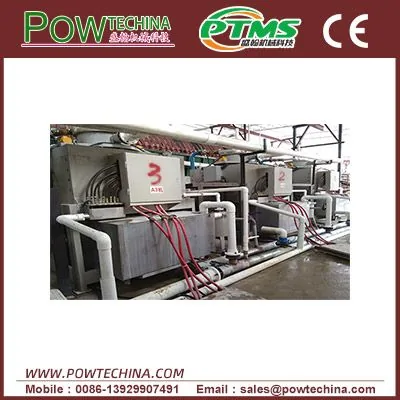
Dispersion, classification, screening, then the electromagnetic slurry separator, automatic iron discharge and dewatering. SHMP and STPP are kaolin dispersants that help liberate iron so the magnet captures it better. Machines to shortlist: A65K750J (oil-cooled, 0–65 kW adjustable), A40K530J (0–40 kW adjustable), Kaolin Water-Cooled Electromagnetic Automatic Magnetic Separator, Model 1000 and the Electromagnetic Slurry Magnetic Separator Series (3A89, 7A190, 11A250, 20A400) for smaller lines. Fine kaolin slurries generally use fine steel wool or dedicated kaolin and feldspar matrix. See the kaolin application page and slurry separator comparison.
Kaolin Iron Removal: questions
How much can a magnetic separator raise kaolin whiteness?
It depends on the kaolin, its iron-bearing minerals and particle size. As an ore-dependent reference, wet high-gradient separation typically lowers Fe₂O₃ by about 20–60% with a whiteness gain of often about 1–5 points. PTMS gives a measured result after a 5–10 kg sample test, within 5 days of receipt.
Can it remove mica, iron oxide and titanium minerals from kaolin?
The PTMS oil-cooled electromagnetic slurry separator series is reported to give an obvious separation effect on weakly magnetic non-metallic minerals such as mica, iron oxide and titanium, which ordinary magnets miss.
What iron cannot be removed magnetically?
Iron inside the kaolinite structure, or coated on mica, is not fully removed and may need flotation or chemical bleaching.
Which PTMS model suits a kaolin slurry line?
Wet electromagnetic slurry separators. Published figures: the 7A160 Wet Magnet has about 30,000 GS theoretical field, a 300 mm cavity and 10–30 m³/h for slurry below 40 mesh; larger lines use the 750 mm A65K750J or 530 mm A40K530J. The model is confirmed from your solids content, particle size and throughput.
How is the captured iron removed from the machine?
Automatically: slurry valves close, remaining slurry drains back, the field is switched off and the matrix is flushed with air ejection and high-pressure water. The matrix has no residual magnetism.
Related guides
Send us your material. We test it free.
Tell us your material, particle size, capacity and target iron level. We usually reply with a matched model and price within 24 hours.