Key takeaways
- India is among the world’s leading producers of industrial minerals that need iron removal: USGS ranks it first for kaolin (~19% of world output, estimated) and talc (~21%), and second for bentonite and feldspar (~18% each). It also produces a meaningful share of world wollastonite (~11%, excluding the United States).[1]
- IBM inventories place china-clay (kaolin) resources at about 2,941 million tonnes, with Kerala (~23%), Rajasthan (~19%), West Bengal (~14%), Odisha (~10%) and Karnataka (~9%) among the largest state shares. Quartz and silica-sand resources are about 3,908 million tonnes; wollastonite resources are concentrated in Rajasthan (~92%).[2][3][4]
- Iron oxide (Fe2O3) lowers brightness and fired colour in Indian kaolin, feldspar, silica sand, talc and ceramic slips. Studies on Indian china clays show free iron oxides respond to high-gradient magnetic separation, while structural iron (for example in some Rajasthan kaolins) is only partly removed and may need bleaching or other steps.[5][6][7]
- Use wet slurry electromagnetic separators for kaolin washing plants, wet-milled feldspar and ceramic slip or glaze. Use dry powder electromagnetic separators (PT3A160, PT20A600, PT25A600, PT1000) for dry-milled feldspar and quartz powder, talc and bentonite. To check a deposit, send PTMS 2–5 kg for a free test; the report comes back within 5 days of receipt.
India’s non-metallic mineral industry at a glance
India’s economy and construction demand support a large industrial-minerals base. In the USGS Minerals Yearbook advance release for 2023, India ranked first worldwide in estimated production of barite, talc and kaolin, and second for bentonite and feldspar. Estimated production that year included about 8.3 million tonnes of crude kaolin (plus about 73,000 t processed), about 6.0 million tonnes of feldspar, about 3.7 million tonnes of bentonite, about 1.4 million tonnes of soapstone/steatite, and 115,458 t of wollastonite.[1]
Domestic demand is driven by cement, ceramics, glass, paper, paint, foundry and plastics. IBM notes that much Indian china clay is still processed by conventional washing and levigation, and that higher-tech processing capacity needs to grow to meet demand for hydrous and calcined clay in paint, plastics, rubber and ceramics.[2] That gap—between abundant ore and the brightness or Fe2O3 limits buyers require—is the commercial case for electromagnetic iron removal on Indian lines.
| Mineral | Main regions and deposits (as named in sources) | Main industrial uses | Sources |
|---|---|---|---|
| Kaolin (china clay) | Resources nationwide; largest shares Kerala, Rajasthan, West Bengal, Odisha, Karnataka. Reported state production includes Rajasthan (for example ~3.98 Mt in 2021–22). Gujarat also holds china-clay resources in the national inventory | Ceramics, cement (crude), paper, paint, rubber, plastics, fillers | [1] [2] [8] |
| Feldspar (K and Na) | Major producer (~18% of world output, estimated). Important producing states include Rajasthan (Ajmer, Alwar, Bhilwara, Jaipur, Pali, Rajsamand, Sikar, Tonk, Udaipur districts named in IBM state reviews) and Telangana/Andhra Pradesh belts | Ceramic glaze and body, glass, sanitaryware, welding electrodes | [1] [9] |
| Quartz / silica sand | Resources ~3,908 Mt; large shares in Haryana, Rajasthan, Andhra Pradesh, Tamil Nadu, Gujarat, Kerala, Telangana and others. Reported silica-sand production includes Gujarat, Andhra Pradesh and Rajasthan | Glass, foundry, ceramics, ferro-silicon, refractories, high-purity quartz | [3] |
| Bentonite | India ~18% of world production (estimated). Gujarat (including Kachchh / Bhuj) and Rajasthan; USGS lists major capacity in Kachchh District, Gujarat | Drilling mud, foundry binder, pelletising, absorbents | [1] [8] |
| Talc / soapstone / steatite | India ~21% of world talc production (estimated). Rajasthan (including Udaipur) historically dominates; Gujarat (Sabarkantha) also produces | Ceramics, paper, plastics, paint, cosmetics | [1] [10] |
| Wollastonite | ~92% of national resources in Rajasthan (Ajmer, Dungarpur, Pali, Sirohi, Udaipur); ~8% in Gujarat (Banaskantha); production reported from Rajasthan | Ceramic tiles, polymers, paint, metallurgical fluxes | [1] [4] |
| Mica | Resources led by Andhra Pradesh (~41%), Rajasthan (~28%), Odisha (~17%); production reported from Andhra Pradesh and Rajasthan | Electrical insulation, paints, rubber, plastics, drilling fluids | [11] |
State and deposit names follow the cited USGS and IBM sources. After 2015, several of these commodities were classified as minor minerals in India, so national production series are incomplete and state figures vary by year of reporting.
Mineral by mineral: quality, and why iron is the problem
Kaolin (china clay)
IBM places china-clay reserves/resources at about 2,941.24 million tonnes (NMI, as on 1.4.2015), of which only about 8% are classified as reserves. About 26% of the inventory is ceramic/pottery grade; a large share remains mixed, unclassified or not-known grade.[2] Kerala, Rajasthan, West Bengal, Odisha and Karnataka hold the largest state shares of resources. Processed china clay is used mainly in ceramics; crude clay goes heavily into cement.[2]
Brightness and Fe2O3 control value. Peer-reviewed and NML studies on Indian kaolins show two different impurity styles:
- Kerala and some western Indian clays often carry free iron oxides/hydroxides (hematite, goethite and related phases). Size classification plus superconducting or high-gradient magnetic separation can cut Fe2O3 and raise ISO brightness. In one SC-HGMS study on western Indian china clay, brightness rose from 72.8% to 79% ISO with about 55% Fe2O3 reduction; TiO2 fell only about 12%.[6][7]
- Some Rajasthan kaolins carry more structural iron in kaolinite or mica; magnetic separation alone is less effective and chemical bleaching may be needed after physical cleaning.[5]
IBM’s outlook calls for more high-tech processing capacity beyond conventional levigation—exactly the role of wet high-gradient electromagnetic separators on Indian china-clay washeries.[2]
Potassium and sodium feldspar
USGS estimates India produced about 6 million tonnes of feldspar in 2023 and ranked second worldwide (~18% of world output).[1] IBM state reviews list extensive feldspar occurrences across Rajasthan districts such as Ajmer, Alwar, Bhilwara, Jaipur, Pali, Rajsamand, Sikar, Tonk and Udaipur, and in Telangana/Andhra Pradesh granitic belts.[9]
Ceramic glaze and glass buyers typically specify low Fe2O3. Iron in Indian feldspar commonly sits in biotite, amphibole, tourmaline, free iron oxides and tramp iron from crushing. Where those minerals are liberated, high-intensity magnetic separation typically removes a large share of the colouring iron; locked inclusions and iron coatings on mica may need finer grinding and flotation as well.[12][13]
Quartz, silica sand and glass sand
IBM reports about 3,907.95 million tonnes of quartz and silica-sand resources (as on 1.4.2015), with large shares in Haryana, Rajasthan, Andhra Pradesh, Tamil Nadu, Gujarat, Kerala and Telangana. Grade classes include glass, foundry/moulding and ceramic/pottery.[3] State production series for silica sand have shown Gujarat, Andhra Pradesh and Rajasthan among the largest reporters in recent IBM compilations.[3]
For clear glass, solar glass and high-purity quartz, even small Fe2O3 increments matter. Iron arrives as heavy minerals, iron-stained grains and mechanical iron from crushers. Magnetic separation is normally placed before acid leaching so tramp iron does not oxidise and stain the sand.
Talc, bentonite, wollastonite and mica
Talc / soapstone / steatite. USGS ranks India first for talc (~21% of world output). Production of soapstone/steatite has been on the order of 1.4 million tonnes per year in recent USGS tables.[1] Older IBM reviews show Rajasthan (including Udaipur) as the dominant producer, with smaller output in Gujarat (Sabarkantha).[10] Goethite and other iron-bearing accessories reduce whiteness of filler grades.
Bentonite. India ranks second worldwide (~18%). Gujarat—especially Kachchh—hosts major mines and processing capacity listed by USGS; Gujarat also holds about 25% of national bentonite resources in IBM state reviews.[1][8] Dry powder electromagnetic separators clean dark speckles and tramp iron without adding water.
Wollastonite. About 92% of India’s resources lie in Rajasthan (Ajmer, Dungarpur, Pali, Sirohi, Udaipur); Gujarat (Banaskantha) holds most of the rest. IBM notes that associated garnet and diopside are removed by high-intensity magnetic separation after grinding.[4] USGS reported 115,458 t of Indian wollastonite production in 2023.[1]
Mica. Andhra Pradesh, Rajasthan and Odisha dominate resources; Andhra Pradesh and Rajasthan report most of the production in recent IBM tables.[11] Iron-rich micas such as biotite are paramagnetic and respond to high-gradient separation when liberated from feldspar or pegmatite feeds.
Why iron and ferromagnetic impurities hurt quality
- Whiteness and brightness. Hematite, goethite and limonite colour kaolin, feldspar, talc and fillers yellow to brown. Brightness is the main paper- and coating-kaolin specification.
- Fired colour and black spots. In tile, porcelain and sanitaryware bodies and glazes, iron darkens the fired colour; metallic iron particles cause black spots after firing.
- Glass colour and transmission. Iron tints glass green and cuts light transmission for clear and solar glass.
- Filler and polymer grades. Dark speckles and high Fe2O3 lower the value of talc, bentonite and wollastonite sold into plastics, paint and ceramics.
What to expect from electromagnetic separation: typical, ore-dependent ranges
Magnetic separation removes only the iron that magnets can capture. Its effect depends on how the iron occurs in the ore:
- Usually well removed: liberated magnetite, hematite, goethite or limonite; iron-bearing silicates such as biotite, tourmaline and amphibole; iron worn off crushers, mills and pipes.
- Removed only partly: thin iron coatings and iron locked inside other grains.
- Not removed: iron inside the crystal structure of kaolinite, smectite or talc.
The table gives indicative ranges from high-gradient magnetic separation practice and published Indian kaolin tests. They are not guarantees and must be confirmed on each ore.
| Material | What the separator can capture | Typical outcome (indicative) | Main limits |
|---|---|---|---|
| Kaolin (wet slurry) | Free limonite/goethite, titanoferrous minerals, iron-bearing mica, tramp iron | Fe2O3 typically about 20–60% lower than in the feed where free iron dominates; published Indian SC-HGMS tests have shown ~55% Fe2O3 cut and multi-point ISO brightness gains | Structural iron (common in some Rajasthan clays); ultra-fine Ti minerals; organics—may need bleaching after magnets |
| K/Na feldspar (wet or dry) | Biotite, tourmaline, amphibole, free iron oxides, tramp iron | Fe2O3 typically about 30–70% lower where iron minerals are liberated; whiteness rises accordingly | Iron coatings on muscovite and locked inclusions need finer grind and often flotation |
| Silica sand / quartz powder | Heavy minerals, iron-stained grains, crusher iron | Fe2O3 typically about 20–50% lower, depending on how much iron is free rather than surface-bound | Surface staining and inclusions usually need scrubbing or acid leaching after magnets |
| Talc, bentonite, wollastonite powder (dry) | Goethite, garnet, diopside, amphibole, tramp iron | Cleaner product with fewer dark specks; colour gains usually modest | Lattice iron stays in the product |
| Ceramic slip and glaze (wet) | Free iron and fine magnetic particles from raw materials and equipment | Typically fewer black spots after firing and a higher first-quality yield | Iron dissolved in frits or locked in raw materials is not affected |
Published research underlines that field strength has diminishing returns once free magnetic iron is gone. In laboratory SC-HGMS work on kaolin, Fe2O3 fell sharply up to about 3.5 T with steel-wool matrix, while higher fields removed little additional iron.[14] The right setting comes from a test on your own Indian ore.
How wet slurry and dry powder electromagnetic separators upgrade Indian kaolin, feldspar and quartz
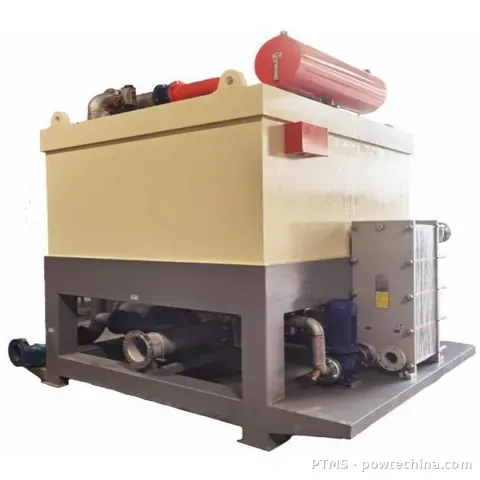
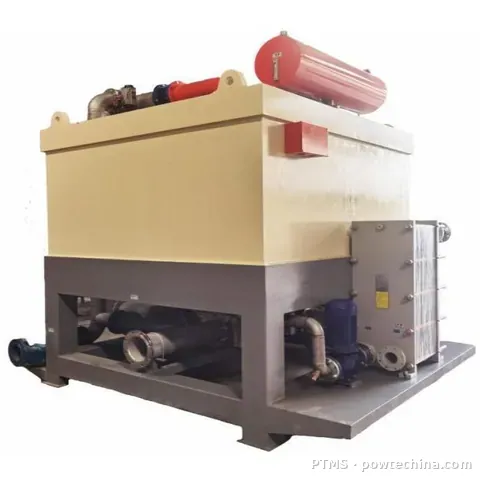
How an electromagnetic slurry separator works
An electromagnetic slurry separator is a wet high-gradient magnetic separator (HGMS).[12] It works in a repeating cycle:
- A copper coil magnetises a stainless-steel matrix (steel wool or grid) inside the separator canister. The matrix concentrates the field into steep gradients.
- Slurry flows through the matrix. On PTMS A-series iron removers it enters at the bottom and leaves at the top (counter-current). Weakly magnetic particles stick to the matrix; cleaned slurry flows on.
- When the matrix is loaded, valves switch, the coil turns off and flush water discharges the iron. The matrix keeps no residual magnetism, so cleaning is complete.
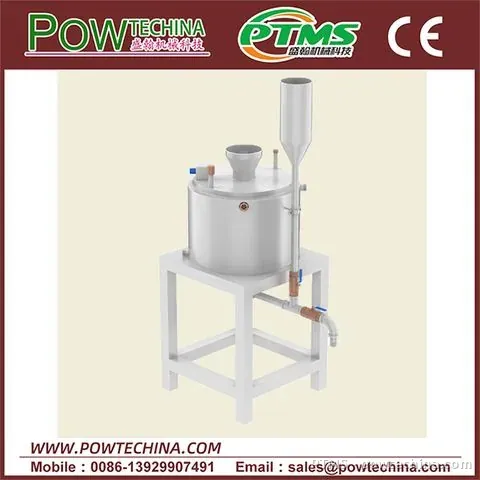
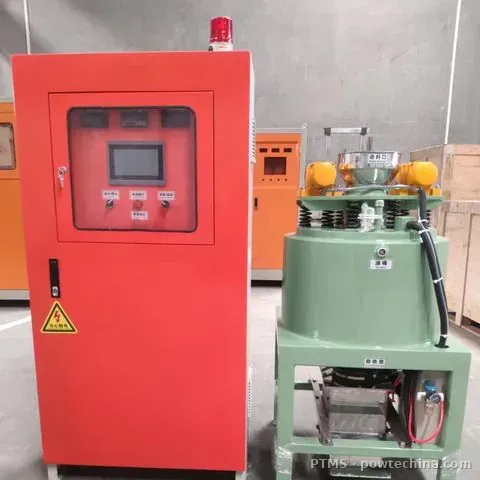
Field strength, matrix type, flow speed and cycle time are the four main settings. Dry electromagnetic powder separators apply the same idea to free-flowing powder: material falls or vibrates through a magnetised zone, and iron is discharged automatically. On PTMS double-discharge quartz powder machines, the powder is cleaned twice in one pass.
Process flow for Indian kaolin
- Dispersion of crude china clay in water (many Indian deposits are soft and dug without blasting).[2]
- Classification with spiral classifiers or hydrocyclones to reject grit, coarse quartz and undecomposed feldspar.
- Screening to protect the separator matrix.
- Electromagnetic slurry separation at high field to capture fine and weakly magnetic iron. A permanent-magnet stage can go first if tramp iron is heavy.
- Automatic flushing of the matrix; iron-rich fraction to tailings.
- Optional chemical bleaching where structural iron or very fine oxides remain and premium brightness is required (especially relevant for some Rajasthan clays).[5]
- Dewatering (filter press) and drying.
Process flow for feldspar (wet and dry lines)
Wet line: crushing → screening → wet grinding → permanent magnetic pre-separation → slurry tank → electromagnetic slurry separator → dewatering. This pattern suits ceramic clusters such as Morbi (Gujarat) and Rajasthan tile/sanitaryware plants that mill feldspar wet.
Dry line: crushing → dry grinding and classification → electromagnetic dry powder separator (PT3A160 / PT20A600 / PT25A600 / PT1000), plus belt magnetic separators for granules.
Where iron coats mica or sits inside feldspar grains, combine magnetic separation with selective grinding and flotation. Magnets before or after flotation cut reagent use and remove mill iron.
Process flow for silica sand and quartz
Crushing (for quartz stone) → washing and attrition scrubbing → classification → magnetic separation:
- Belt-type rare-earth roller separators for granules of about 0.1–10 mm
- Dry electromagnetic powder separators (PT3A160–PT25A600, PT1000) for fine quartz powder
- Wet slurry separators on wet lines
Place magnets before acid leaching so crusher iron does not oxidise and stain the sand. Glass and PV-grade projects in Gujarat, Andhra Pradesh, Rajasthan and elsewhere typically need this sequence.[3]
Talc, bentonite, wollastonite and ceramic slip or glaze
- Talc, bentonite and wollastonite powders: dry electromagnetic powder separators. For wollastonite, IBM already describes high-intensity magnetic separation to remove garnet and diopside after grinding.[4]
- Tile, sanitaryware and tableware plants: wet electromagnetic separators on glaze and body slip remove fine iron just before use, cutting black spots after firing. India’s large ceramic base in Gujarat (Morbi), Rajasthan and elsewhere makes glaze/slip iron removal a high-volume application.
Wet or dry: how to choose
| Question | Wet slurry separator | Dry powder separator |
|---|---|---|
| What form is your material in? | Already a slurry: kaolin washing plants, wet-milled feldspar, ceramic slip and glaze | Dry, free-flowing powder or granules: dry-milled feldspar or quartz, talc, bentonite, dried glass sand |
| Particle size | Fine slurries; as a published PTMS reference, the 7A160 Wet Magnet is rated for slurry below 40 mesh | Fine powder in electromagnetic powder machines; 0.1–10 mm granules on belt-type roller separators |
| Fine, weakly magnetic iron | Best choice: particles are dispersed and the high-gradient matrix catches very fine iron | Effective on dry powder, but material must stay dry and free-flowing |
| Water and drying | Needs process and flushing water; product must be dewatered | No water and no extra drying step—useful in arid mining districts |
Choosing field strength, cooling and matrix
- Field strength. Tramp iron is caught at low field. Weakly magnetic minerals such as goethite, biotite and tourmaline need a high-intensity field plus a high-gradient matrix. Published PTMS figures:
- A65K750J (750 mm cavity) and A40K530J (530 mm cavity) slurry iron removers: 0–20,000 GS, adjustable
- 7A160 Wet Magnet: about 30,000 GS theoretical
- Electromagnetic Dry Powder Magnetic Separator Series — PT20A600 published at 2.5 T, 600 mm cavity, water + oil dual cooling, about 2–4 t/h; PT3A160, PT25A600 and PT1000 configured per ore after testing
- Dry Magnet PT3A160 for smaller dry powder lines
- Cooling. Continuous high-field operation generates heat in the coil. Hot, dusty Indian plant rooms make cooling important. The A65K750J is oil-cooled, the A40K530J uses combined oil and water cooling, and water-cooled designs such as the 750 Water Cooling Wet Type Magnet and Electromagnetic Slurry Magnetic Separator Type 1000 (PT1000 class) keep the field stable over long shifts.
- Matrix. Fine kaolin and feldspar slurries generally use fine steel wool matrix or dedicated kaolin and feldspar matrix. Coarser feeds use grid matrices. Screening ahead of the separator protects the matrix.
- Capacity. Throughput depends on solids content, particle size and target iron level. PTMS confirms the model size after the sample test rather than quoting a generic t/h figure.
PTMS models to shortlist for Indian plants
- Kaolin slurry: A65K750J, A40K530J, the Kaolin Water-Cooled Electromagnetic Automatic Magnetic Separator, Model 1000, Type 1000 / PT1000-class slurry separator, and the Electromagnetic Slurry Magnetic Separator Series.
- Feldspar: Potassium Sodium Feldspar Magnetic Separator and the 750 water-cooled model for wet lines; dry electromagnetic models PT3A160, PT20A600, PT25A600 and PT1000 for dry powder lines (dry powder series, PT3A160).
- Quartz and silica sand: Dry Separator for Quartz Powder (Double Discharge), dry electromagnetic PT models above, and the Fully Automatic 3-Layer Belt Magnetic Separator for granules.
- Bentonite and talc powder: Electromagnetic Bentonite Powder Magnetic Separator and the dry powder PT series.
- Ceramic glaze and slip: Electromagnetic Magnetic Separator for Ceramic Glaze (WS series, 2–3.5 T).
Material guides: kaolin, feldspar, quartz sand and quartz stone, ceramics.
Test your Indian ore free before you invest
Indian deposits vary even within one state, so a measured result on your own material is the only reliable basis for choosing a separator. PTMS tests your material free of charge:
- Send 2–5 kg of kaolin, feldspar, quartz sand, talc, bentonite, wollastonite or ceramic slurry or powder to our factory in Foshan, Guangdong, China.
- Within 5 days of receiving the sample, we send a test report with before-and-after iron content (and whiteness where relevant).
- The report includes a recommended wet or dry model (including PT3A160, PT20A600, PT25A600 or PT1000 where appropriate), field strength and process flow.
Request a free sample test WhatsApp +86 139 2990 7491
You can also email sales@powtechina.com. Please include your material, particle size, capacity (t/h or m³/h), solids content for slurries, current Fe2O3 or whiteness, and your target. An India contact line is also listed on the site: +91 8184822299.
Sources
- U.S. Geological Survey (2025). The Mineral Industry of India in 2023. Minerals Yearbook, Volume III, Area Reports: International — Asia and the Pacific (advance release). https://pubs.usgs.gov/myb/vol3/2023/myb3-2023-india.pdf
- Indian Bureau of Mines (2023). Indian Minerals Yearbook 2022, Part-III: Mineral Reviews — Kaolin, Ball Clay, Clay (Others) and Shale (Minor Minerals chapter). https://ibm.gov.in/writereaddata/files/1712755949661694ed25be0kaolin.pdf
- Indian Bureau of Mines (2023). Indian Minerals Yearbook 2022, Part-III: Mineral Reviews — Quartz & Other Silica Minerals (Minor Minerals chapter). https://ibm.gov.in/writereaddata/files/17127561246616959ca1068Quartz.pdf
- Indian Bureau of Mines (2022). Indian Minerals Yearbook 2021, Part-III: Mineral Reviews — Wollastonite. https://ibm.gov.in/writereaddata/files/168319684764538baf96189Wollastonite_2021.pdf
- Chandrasekhar S., Ramaswamy S. (2002). Influence of mineral impurities on the properties of kaolin and its thermally treated products. Applied Clay Science 21(3–4): 133–142. https://doi.org/10.1016/S0169-1317(01)00083-7
- Chandrasekhar S., Ramaswamy S. (2006). Iron minerals and their influence on the optical properties of two Indian kaolins. Applied Clay Science 33(3–4): 269–277. https://doi.org/10.1016/j.clay.2006.06.008
- Saikia N.J., Bharali D.J., Sengupta P., Bordoloi D., Goswamee R.L., Saikia P.C., Borthakur P.C. (2003). Characterization, beneficiation and utilization of a kaolinite clay from Assam, India. Applied Clay Science 24(1–2): 93–103. https://doi.org/10.1016/S0169-1317(03)00151-0
- Indian Bureau of Mines (2023). Indian Minerals Yearbook 2022, Volume III — Mineral Reviews (full volume; includes bentonite, china clay, feldspar-related minor minerals). https://ibm.gov.in/writereaddata/files/174963836168495cd990ccdIMYB2022_Volume_III.pdf
- Indian Bureau of Mines (2020). Indian Minerals Yearbook 2020 — Quartz and Other Silica Minerals (resource and state production tables). https://ibm.gov.in/writereaddata/files/07132021132649Quartz%20and%20Other%20Silica%20Minerals%202020.pdf
- Indian Bureau of Mines portal — Indian Minerals Yearbook 2022 Vol. III Mineral Reviews index. https://ibm.gov.in/IBMPortal/pages/indian-minerals-yearbook--2022-vol--iii--mineral-reviews-
- Indian Bureau of Mines (2022). Indian Minerals Yearbook 2021, Part-III: Mineral Reviews — Mica. https://ibm.gov.in/writereaddata/files/1683715413645b7555d763416_Mica.pdf
- Svoboda J., Fujita T. (2003). Recent developments in magnetic methods of material separation. Minerals Engineering 16(9): 785–792. https://doi.org/10.1016/S0892-6875(03)00212-7
- Oberteuffer J.A. (1974). Magnetic separation: a review of principles, devices, and applications. IEEE Transactions on Magnetics 10(2): 223–238. (IEEE Xplore abstract; principles of magnetic capture). https://ieeexplore.ieee.org/document/1058368
- Iannicelli J. (1976). New developments in magnetic separation. IEEE Transactions on Magnetics 12(5): 489–496. https://doi.org/10.1109/TMAG.1976.1059107
- High gradient magnetic separation of china clays (Springer / Bulletin of Materials Science). https://link.springer.com/article/10.1007/BF02744661
- Indian Bureau of Mines portal — Indian Minerals Yearbook 2021 Vol. III Mineral Reviews index. https://ibm.gov.in/IBMPortal/pages/Indian_Minerals_Yearbook__2021__Vol__III__Mineral_Reviews_