Key takeaways
- Vietnam has kaolin, feldspar, white silica sand, talc, bentonite, mica, graphite and diatomite. Kaolin and feldspar come mainly from weathered pegmatites and granites along the Red River belt (Lao Cai, Yen Bai, Phu Tho) and from deposits in Lam Dong, Quang Nam, Quang Ninh and Binh Duong. Silica sand runs along the coast from Quang Ninh to Kien Giang.[3][4]
- Vietnamese geologists report that most explored kaolin deposits do not reach commercial grade without beneficiation, and that iron oxide (Fe2O3) is the main harmful impurity.[4] Raw feldspar from Quang Nam has been measured at 0.51–1.00% Fe2O3 (average 0.75%). Vietnam's standard for feldspar used in ceramic glazes allows at most 0.3%.[5][6]
- Electromagnetic (high-gradient) separators remove the iron that magnets can capture: free iron oxides, biotite and other iron-bearing minerals, and iron worn off mills and pipes. How much Fe2O3 they remove, and how much whiteness improves, depends on how the iron occurs in each ore. Typical, ore-dependent ranges are given below.
- Use wet slurry separators for kaolin, wet-milled feldspar and ceramic slip or glaze. Use dry powder separators for dry-milled feldspar and quartz powder, talc and bentonite. To check a deposit, send PTMS 5–10 kg for a free test. The report comes back within 5 days of receipt.
Vietnam's non-metallic mineral industry at a glance
Vietnam has a wide range of industrial minerals, but reliable production figures for most of them are hard to find. The U.S. Geological Survey (USGS) lists kaolin, bentonite, silica, pyrophyllite and refractory clay among the commodities that Vietnam "may have produced" but for which data were not good enough to estimate output.[1] The USGS also reports that in January 2024 Vietnam's Ministry of Natural Resources and Environment announced 489 newly identified sites for possible future mining, including feldspar, kaolin and graphite.[2]
Demand at home is large. Vietnam's building-ceramics industry produced about 504 million m² of tiles in 2024 (a 27% recovery on 2023), making it one of the world's largest tile producers. It also made about 14.5 million sanitaryware pieces and exported more than US$245 million of tiles.[12][13] Glass, paper, paint and, more recently, high-purity quartz projects create further demand. Vietnamese researchers note that high-grade kaolin and feldspar are still partly imported, while much locally mined material is sold raw or only lightly processed.[4][5] That gap is the commercial case for better beneficiation, and especially for iron removal.
| Mineral | Main regions and deposits (as named in sources) | Main industrial uses | Sources |
|---|---|---|---|
| Kaolin | Weathered pegmatites along the Red River from Lao Cai to Phu Tho (Thach Khoan area, Doi Dao, Huu Khanh in Phu Tho; Truc Binh, Tan Thinh in Yen Bai; Son Man in Lao Cai). Weathered granite (Trai Mat, Lam Dong; Dinh Trung, Vinh Phuc). Sedimentary kaolin (Dat Cuoc, Chanh Luu, Binh Duong). Kaolin–pyrophyllite (Tan Mai, Quang Ninh). Bac Ly (Quang Binh) | Porcelain, sanitaryware, tiles, electrical porcelain, paper filler, refractories | [3] [4] |
| Feldspar (potassium and sodium) | Granite pegmatites in Phu Tho, Lao Cai, Yen Bai, Quang Nam and Ba Ria–Vung Tau. About 20 deposits are worked at rated capacities of 30–100 kt/year | Ceramic glaze, tile body, sanitaryware, glass, welding electrodes | [3] [5] |
| White silica (glass) sand | Coastal belt from Quang Ninh to Kien Giang: Thuy Trieu (Cam Lam, Khanh Hoa), Van Hai (Quang Ninh), Phong Dien (Thua Thien-Hue), Ba Don (Quang Binh) and southern Quang Tri | Container and flat glass, foundry, ceramics, high-purity quartz | [1] [7] [8] [9] |
| Talc | Thu Ngac, Thanh Son district (Phu Tho); altered dolomite in the middle Da River basin; ultramafic-hosted talc along the Song Ma zone | Ceramics, paper, plastics, paint | [3] [10] |
| Bentonite | Tam Bo, Di Linh (Lam Dong); Nha Me, Tuy Phong (Binh Thuan). 25 occurrences found, 2 explored and mined | Drilling mud, foundry sand binder, pelletising, absorbents | [3] [11] |
| Mica, graphite, diatomite | Muscovite in pegmatites of Lao Cai, Phu Tho and Quang Nam. Graphite in Lao Cai and Yen Bai (Nam Thi, Bao Yen; Yen Thai, Van Yen). Diatomite in Lam Dong, Phu Yen and Kon Tum | Fillers, insulation; graphite for refractories and battery anodes; filtration | [1] [3] |
Province names follow the cited sources. Under Resolution 202/2025/QH15, Vietnam merged its provinces into 34 provincial-level units from 1 July 2025. For example, Yen Bai is now part of Lao Cai, Vinh Phuc and Hoa Binh are part of Phu Tho, and Quang Binh is part of Quang Tri.[16]
Mineral by mineral: quality, and why iron is the problem
Kaolin
Vietnamese kaolin forms in three ways. Most of it comes from weathered pegmatite, granite and volcanic rock. Some is sedimentary (for example Dat Cuoc in Binh Duong), and some is hydrothermal kaolin–pyrophyllite (Tan Mai in Quang Ninh). A review by geologists at the Department of Geology and Minerals of Vietnam counted 267.9 million tonnes of kaolin resources and reserves in 67 explored deposits.[4] Other national inventories give larger figures for all known occurrences.[3]
Iron content varies a lot by deposit type and weathering zone. The same review reports these Fe2O3 ranges:[4]
- Strongly weathered zone of pegmatite kaolin: 1–3.5%
- Medium-weathered zone of pegmatite kaolin: 0.5–2.5%
- Sedimentary kaolin: 0.5–7%
- Tan Mai kaolin–pyrophyllite: as low as 0.01–0.07%
For comparison, fine ceramics are quoted as needing Fe2O3 no higher than 0.4–1.5%. The 2008 review concludes that most explored Vietnamese kaolin is below commercial grade, has high iron and needs beneficiation. It also notes that high-quality kaolin for paper and premium ceramics is still imported.[4] In a 2023 study of the Di Nau kaolin–feldspar area (Tam Nong, Phu Tho), raw kaolin did not meet the SiO2 and Al2O3 criteria of the national standard for sanitaryware and tiles (TCVN 6201:1997) without beneficiation.[6]
Potassium and sodium feldspar
Vietnam has substantial feldspar reserves, but most lie in the weathered or semi-weathered zones of pegmatites. As a result, the ore has a complex mineral make-up. Mining and sorting are often manual, which gives uneven quality and leaves the country importing high-grade feldspar.[5]
A study of Quang Nam quartz–feldspar ore measured 0.51–1.00% Fe2O3 (average 0.75%), 14.20% Al2O3 and 75.27% SiO2. The iron sat in iron-mineral coatings on muscovite and as inclusions in the feldspar.[5] Vietnamese standard TCVN 6598:2000 sets iron oxide limits of at most 0.3% for feldspar used in ceramic glazes and at most 0.5% for ceramic bodies.[6] Many raw feldspars therefore need iron removal before they can be sold as glaze grade.
White silica sand and quartz
Vietnam's coastal white sands are among its best-known industrial minerals. Khanh Hoa province reports more than 64 million tonnes of glass sand around Cam Ranh and Cam Lam, with SiO2 around 99.7%. The province also moved to stop exports of raw or barely processed white sand from the end of 2012 and keep the resource for domestic processing.[7]
Marine-aeolian sands at Ba Don (Quang Binh) and Phong Dien (Thua Thien-Hue) analysed at 99.10% SiO2 with 0.06% Fe2O3 and 0.34% FeO. After processing they meet requirements for ceramics, foundry moulds, refractories, abrasives and glass.[8] USGS lists several silica sand producers, including Cam Ranh FICO Sand (about 500,000 t/year capacity), Viglacera Van Hai and Viet Phuong Group.[1] Quang Tri province reports five white and quartz sand mines covering more than 1,075 ha, holding about 56.4 million tonnes, and a high-purity quartz project for semiconductor and photovoltaic use.[9]
For clear glass, solar glass and high-purity quartz, even small amounts of iron matter. They come from iron-bearing heavy minerals, iron-stained grains and iron picked up during crushing.
Talc, bentonite, mica and graphite
Talc from Thu Ngac (Thanh Son, Phu Tho) is described as very pure, with few accessory minerals (chlorite, amphibole and goethite).[10] The goethite and amphibole are the iron-bearing, weakly magnetic part. Bentonite is mined at Tam Bo in Di Linh (Lam Dong) and has been explored at Nha Me in Tuy Phong (Binh Thuan). The Ministry of Industry and Trade planned 100,000–150,000 t/year of processing capacity for Nha Me 2.[11] Muscovite occurs in the same pegmatite belts as feldspar.[3] Iron-rich micas such as biotite are paramagnetic and can be separated magnetically. Graphite from Lao Cai and Yen Bai links Vietnam's mineral base to battery-anode supply chains, where magnetic iron contamination must be very low.[1]
Why iron and ferromagnetic impurities hurt quality
- Whiteness and brightness. Iron oxides and hydroxides (hematite, goethite, limonite) colour kaolin, feldspar, talc and fillers yellow to brown. Brightness is the main specification for paper and coating kaolin.
- Fired colour and defects. In tile, porcelain and sanitaryware bodies and glazes, iron darkens the fired colour. Fine particles of metallic iron cause black spots, one of the most visible ceramic defects.
- Glass colour and light transmission. Iron gives glass a green tint and reduces light transmission, which is critical for clear and solar glass.
- Battery and electronic materials. Metallic iron particles in graphite and other battery materials are a safety and quality risk.
What to expect from electromagnetic separation: typical, ore-dependent ranges
Magnetic separation removes only the iron that magnets can capture. Its effect depends on how the iron occurs in the ore:
- Usually well removed: liberated grains of magnetite, hematite, goethite or limonite; iron-bearing silicates such as biotite, tourmaline and amphibole; iron worn off crushers, mills and pipes.
- Removed only partly: thin iron coatings and iron locked inside other grains.
- Not removed: iron inside the crystal structure of kaolinite, smectite or talc.
The table gives indicative ranges from general high-gradient magnetic separation practice. They are not guarantees and are not results measured on Vietnamese ore.
| Material | What the separator can capture | Typical outcome (indicative) | Main limits |
|---|---|---|---|
| Kaolin (wet slurry) | Limonite and goethite grains, titanomagnetite, iron-bearing mica, iron from processing | Fe2O3 typically 20–60% lower than in the feed; whiteness or brightness typically a few points higher (often about 1–5) | Iron in the kaolinite lattice, very fine titanium minerals and organic colour may need chemical bleaching or other steps |
| Potassium and sodium feldspar (wet or dry) | Biotite, tourmaline, amphibole, free iron oxides, iron from processing | Fe2O3 typically 30–70% lower where the iron minerals are liberated; whiteness rises accordingly | Iron coatings on muscovite and locked inclusions (as found in Quang Nam ore) may need finer grinding and flotation as well |
| Silica sand and quartz powder (dry or wet) | Iron-bearing heavy minerals, iron-stained grains, iron from crushing | Fe2O3 typically 20–50% lower, depending on how much iron is free rather than surface-bound | Surface staining and inclusions usually need scrubbing or acid leaching after magnetic separation |
| Talc and bentonite powder (dry) | Goethite, amphibole and chlorite grains, iron from processing | Mainly cleaner product with fewer dark specks; colour gains are usually modest | Iron inside the clay or talc structure stays in the product |
| Ceramic slip and glaze (wet) | Free iron and fine magnetic particles from raw materials and equipment | Typically fewer black spots after firing and a higher first-quality yield | Iron dissolved in frits or locked in raw materials is not affected |
Published research shows how strongly results depend on the ore and the field. In a pilot study on kaolinite recovered from rare-earth tailings in southern China, a wet high-gradient separator at 0.6 T removed the magnetic titanomagnetite and limonite and cut Fe2O3 from 2.93% to 1.21%. The iron left in non-magnetic minerals would need chemical treatment.[15] In the laboratory part of the same study, iron removal rose steeply up to 0.6 T but improved by only about 4.7% more between 0.6 and 1.0 T. A higher field is not automatically better value. The right setting comes from a test on your own material.[15]
How wet slurry and dry powder electromagnetic separators upgrade Vietnam's kaolin, feldspar and quartz
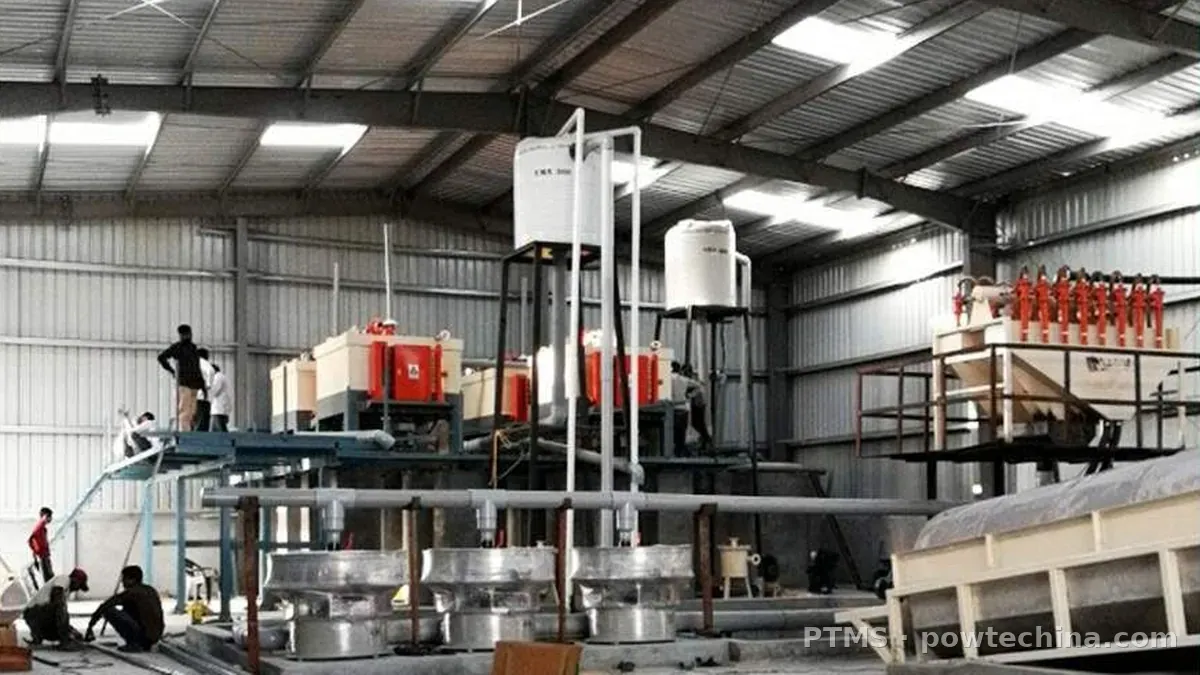
How an electromagnetic slurry separator works
An electromagnetic slurry separator is a wet high-gradient magnetic separator (HGMS).[14] It works in a repeating cycle:
- A copper coil magnetises a stainless-steel matrix (steel wool or grid) inside the separator canister. The matrix concentrates the field into very steep gradients.
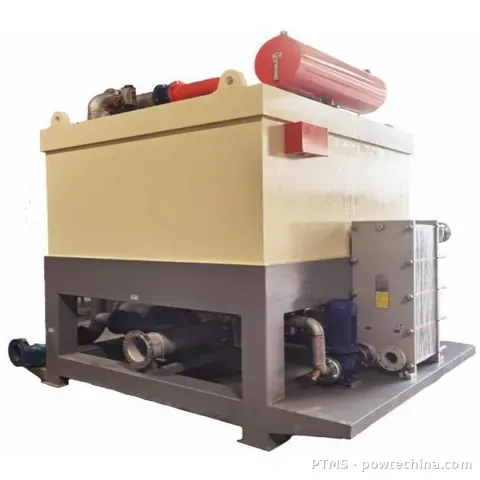
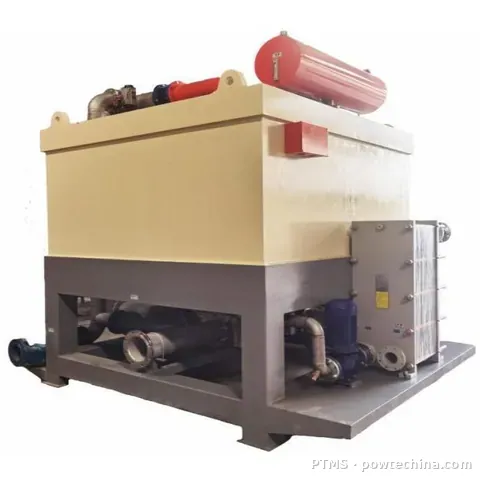
- Slurry flows through the matrix. On PTMS A-series iron removers it enters at the bottom and leaves at the top, in counter-current flow. Weakly magnetic particles stick to the matrix wires, and the cleaned slurry flows on.
- When the matrix is loaded, the valves switch, the coil turns off and the matrix is flushed with water to discharge the iron. The matrix keeps no residual magnetism, so the iron flushes out fully.
Field strength, matrix type, flow speed and cycle time are the four main settings.
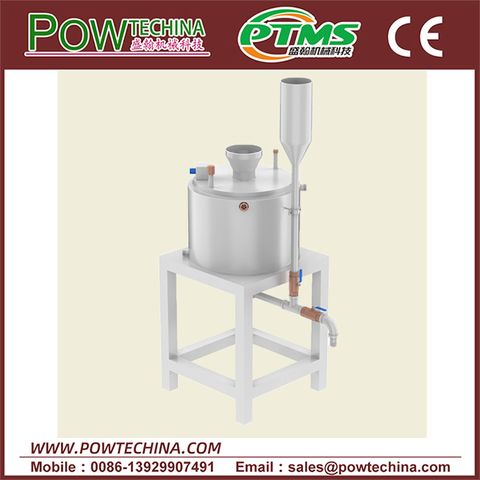
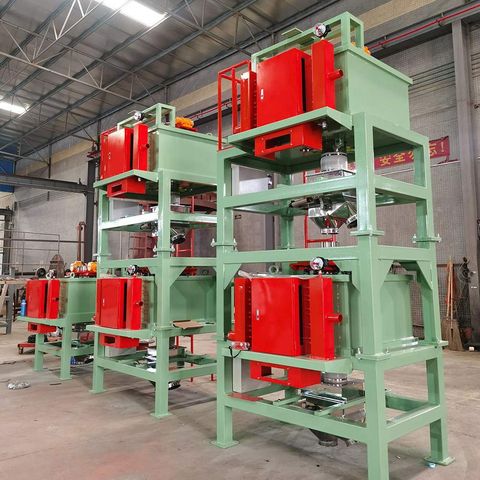
Dry electromagnetic powder separators apply the same principle to free-flowing powder. The material falls or vibrates through a magnetised matrix or high-intensity zone, and the iron is discharged automatically. On PTMS double-discharge quartz powder machines, the powder is cleaned twice in one pass.
Process flow for Vietnamese kaolin
- Dispersion of the raw (often weathered pegmatite or granite) kaolin in water.
- Classification with a spiral classifier or hydrocyclones to reject coarse quartz and undecomposed feldspar. In many Vietnamese pegmatite kaolins only about 20–60% of the mass passes 0.21 mm, so this step matters.[4]
- Screening to remove grit and oversize, which protects the separator matrix.
- Electromagnetic slurry separation at high field to capture fine and weakly magnetic iron minerals. If tramp iron is heavy, a permanent magnet stage can go first.
- Automatic flushing of the matrix. The iron-rich fraction goes to tailings.
- Optional chemical bleaching where lattice iron or very fine iron oxides remain and a premium brightness is required.
- Dewatering (filter press) and drying.
Process flow for feldspar (wet and dry lines)
Wet line: crushing → screening → wet grinding → permanent magnetic pre-separation to remove strongly magnetic material → slurry tank → electromagnetic slurry separator to remove fine and weakly magnetic iron → dewatering.
Dry line: crushing → dry grinding and classification → electromagnetic dry powder separator, plus belt magnetic separators for granules.
For ores like the Quang Nam pegmatite, where iron coats mica and sits inside feldspar grains, magnetic separation is often combined with selective grinding and flotation of mica and iron minerals. The aim is glaze-grade iron levels.[5] In that case, a magnetic stage before or after flotation reduces reagent use and removes the iron from milling.
Process flow for silica sand and quartz
Crushing (for quartz stone) → washing and attrition scrubbing → classification → magnetic separation:
- Belt-type rare-earth roller separators for granules of about 0.1–10 mm
- Dry electromagnetic powder separators for fine quartz powder
- Wet slurry separators on wet lines
Magnetic separation comes before any acid leaching. It removes the iron from crushing before it oxidises and stains the sand. For high-purity quartz such as the projects planned in Quang Tri, magnetic separation is one stage in a longer purification route.[9]
Talc, bentonite and ceramic slip or glaze lines
- Talc and bentonite powders: dry electromagnetic powder separators.
- Tile, sanitaryware and tableware plants: wet electromagnetic separators on glaze and body slip remove fine iron just before use, which reduces black spots after firing. With tile output of about 504 million m² in 2024, glaze and slip iron removal is a large application in Vietnam.[12]
Wet or dry: how to choose
| Question | Wet slurry separator | Dry powder separator |
|---|---|---|
| What form is your material in? | Already a slurry: kaolin washing plants, wet-milled feldspar, ceramic slip and glaze | Dry, free-flowing powder or granules: dry-milled feldspar or quartz, talc, bentonite, dried glass sand |
| Particle size | Fine slurries; as a published PTMS reference, the 7A160 Wet Magnet is rated for slurry below 40 mesh | Fine powder in electromagnetic powder machines; 0.1–10 mm granules on belt-type roller separators |
| Fine, weakly magnetic iron | Best choice: particles are dispersed and the high-gradient matrix catches very fine iron | Effective on dry powder, but material must stay dry and free-flowing |
| Water and drying | Needs process and flushing water; product must be dewatered | No water and no extra drying step |
Choosing field strength, cooling and matrix
- Field strength. Tramp iron is caught at low field. Weakly magnetic minerals such as goethite, biotite and tourmaline need a high-intensity field plus a high-gradient matrix. Published PTMS figures:
- A65K750J (750 mm cavity) and A40K530J (530 mm cavity) slurry iron removers: 0–20,000 GS, adjustable
- 7A160 Wet Magnet: about 30,000 GS theoretical
- Electromagnetic Dry Powder Machine: 18,000–30,000 GS in the working cavity
- Dry powder 3K160–20K600 series: 2–3.5 T
- Cooling. Continuous high-field operation generates heat in the coil, and Vietnam's tropical climate makes cooling more important. The A65K750J is oil-cooled, the A40K530J uses combined oil and water cooling, and water-cooled designs such as the 750 Water Cooling Wet Type Magnet are also available. All of them keep the field stable over long shifts.
- Matrix. Fine kaolin and feldspar slurries generally use fine steel wool matrix or dedicated kaolin and feldspar matrix. Coarser feeds use grid matrices, which resist clogging. Screening ahead of the separator protects the matrix.
- Capacity. Throughput depends on solids content, particle size and target iron level. PTMS confirms the model size after the sample test rather than quoting a generic t/h figure.
PTMS models to shortlist for Vietnamese plants
- Kaolin slurry: A65K750J (oil-cooled, 0–65 kW adjustable), A40K530J (0–40 kW adjustable), the Kaolin Water-Cooled Electromagnetic Automatic Magnetic Separator, Model 1000, and the Electromagnetic Slurry Magnetic Separator Series (3A89, 7A190, 11A250, 20A400) for smaller lines.
- Feldspar: Potassium Sodium Feldspar Magnetic Separator and the 750 water-cooled model for wet lines; the Electromagnetic Dry Powder Machine for dry lines.
- Quartz and silica sand: Dry Separator for Quartz Powder (Double Discharge), 7A300 Quartz Sand Electromagnetic Separator, and the Fully Automatic 3-Layer Belt Magnetic Separator for granules.
- Bentonite and talc powder: Electromagnetic Bentonite Powder Magnetic Separator.
- Ceramic glaze and slip: Electromagnetic Magnetic Separator for Ceramic Glaze (WS series, 2–3.5 T).
- Graphite for batteries: Graphite Magnetic Separator.
Material guides: kaolin, feldspar, quartz sand and quartz stone, ceramics.
Test your Vietnamese ore free before you invest
Vietnamese deposits vary even within one province, so a measured result on your own material is the only reliable basis for choosing a separator. PTMS tests your material free of charge:
- Send 5–10 kg of kaolin, feldspar, quartz sand, talc, bentonite or ceramic slurry or powder to our factory in Foshan, Guangdong, China.
- Within 5 days of receiving the sample, we send a test report with before-and-after iron content (and whiteness where relevant).
- The report includes a recommended wet or dry model, field strength and process flow.
Request a free sample test WhatsApp +86 139 2990 7491
You can also email sales@powtechina.com. Please include your material, particle size, capacity (t/h or m³/h), solids content for slurries, current Fe2O3 or whiteness, and your target.
Sources
- Moon, Ji Won — U.S. Geological Survey (2024). The Mineral Industry of Vietnam in 2022. Minerals Yearbook, Volume III, Area Reports: International (advance release). https://pubs.usgs.gov/myb/vol3/2022/myb3-2022-vietnam.pdf
- U.S. Geological Survey, National Minerals Information Center. Vietnam: country mineral information (2024 data). https://www.usgs.gov/centers/national-minerals-information-center/vietnam
- Nguyen Ngoc Khoi (2014). Mineral Resources Potential of Vietnam and Current State of Mining Activity. Applied Environmental Research 36(1): 37–46. https://doi.org/10.35762/aer.2014.36.1.6
- Le Do Tri, Nguyen Phuong, Nguyen Trong Toan (2008). Kaolin potential of Vietnam and orientation of exploration and mining (in Vietnamese). Department of Geology and Minerals of Vietnam / Hanoi University of Mining and Geology. http://idm.gov.vn/nguon_luc/Xuat_ban/2008/A307/a75.htm
- Yushina T.I., Nguyen Thu Thuy, Dumov A.M., Nguyen Van Trong (2021). Features of material constitution of quartz–feldspar ore from Quang Nam deposit in Vietnam. Eurasian Mining, No. 1, pp. 49–54. https://doi.org/10.17580/em.2021.01.10
- Nguyen Thi Thanh Thao et al. (2023). Quality characteristics and resource potential of kaolin–feldspar in the Di Nau area, Tam Nong district, Phu Tho province (in Vietnamese). Tạp chí Công Thương (Industry and Trade Magazine). https://tapchicongthuong.vn/dac-diem-chat-luong-va-tiem-nang-tai-nguyen-nguyen-kaolin--felspat-khu-di-nau--huyen-tam-nong--tinh-phu-tho-111975.htm
- Vietnam Government News (baochinhphu.vn). Khanh Hoa: ending the mining of raw white sand for export in 2012 (in Vietnamese). https://baochinhphu.vn/khanh-hoa-nam-2012-cham-dut-viec-khai-thac-cat-trang-tho-de-xuat-khau-102107917.htm
- Duong Van Huan, Bien Xuan Thanh (2010). Quality and usability of white sand in Ba Don (Quang Binh) and Phong Dien (Thua Thien Hue). Journal of Geology (Tạp chí Địa chất), Series A, No. 319. https://journalofgeology.vn/index.php/home/article/view/173
- Sức khỏe & Đời sống (2026). Quang Tri attracts investment in semiconductor and high-tech materials (in Vietnamese; quotes the Quang Tri Department of Agriculture and Environment). https://suckhoedoisong.vn/quang-tri-thu-hut-dau-tu-nganh-vat-lieu-ban-dan-va-vat-lieu-cong-nghe-cao-169260809085518213.htm
- Dumas A., Martin F., Ke Tran Huu et al. (2015). The crystal-chemistry of Vietnamese talcs from the Thanh Son district (Phu Tho province, Vietnam). Clay Minerals 50(5): 607–617. https://doi.org/10.1180/claymin.2015.050.5.05
- Vietnam Government News (baochinhphu.vn). Ministry of Industry and Trade adds the Nha Me 2 bentonite mine (Tuy Phong, Binh Thuan) to the industrial minerals plan (in Vietnamese). https://baochinhphu.vn/bo-cong-thuong-bo-sung-quy-hoach-ve-tham-do-khai-thac-che-bien-va-su-dung-nhom-khoang-chat-cong-nghiep-tai-tinh-binh-thuan-10275568.htm
- Ceramic World Review / MECS–Acimac Research Centre (2025). World production and consumption of ceramic tiles (2024). https://www.ceramicworldweb.com/en/economics-and-markets/world-production-and-consumption-ceramic-tiles-2024
- Vietnam Building Ceramics Association (2025). Members' meeting reviewing 2024 and planning 2025 (in Vietnamese). http://vnceramic.org.vn/hoat-dong-hiep-hoi/hiep-hoi-hop-doanh-nghiep-hoi-vien-tong-ket-nam-2024-va-dinh-huong-nam-2025.htm
- Svoboda J., Fujita T. (2003). Recent developments in magnetic methods of material separation. Minerals Engineering 16(9): 785–792. https://doi.org/10.1016/S0892-6875(03)00212-7
- Wang Y. et al. (2016). Separation of Kaolinite from Ion-Adsorption Rare Earth Tailings in Southern China and Iron Removal Treatment. Journal of Minerals and Materials Characterization and Engineering 4. https://doi.org/10.4236/jmmce.2016.41005
- National Assembly of Vietnam (2025). Resolution 202/2025/QH15 on the reorganization of provincial-level administrative units (English translation, LuatVietnam). https://english.luatvietnam.vn/co-cau-to-chuc/resolution-202-2025-qh15-reorganization-of-provincial-level-administrative-divisions-402728-d1.html